Short answer
Google Ads management pricing usually follows one of three models: a percentage of your ad spend (commonly 10% to 20%), a flat monthly fee (commonly $500 to $2,000 for small and mid-sized accounts), or a hybrid with a minimum fee, according to AgencyAnalytics (July 2025).
A flat fee takes a bigger share of a small budget and a smaller share as spend grows. Whatever the model, keep the account in your name, avoid long lock-ins, and get reports that show Google’s exact cost.
Key takeaways
- Percentage of spend is still the default quote. AgencyAnalytics puts the Google Ads norm at 10% to 20% of monthly ad spend, and Straight North publishes $1,000 or 15%, whichever is greater.
- Flat fees win as your budget grows. On the published price lists we compared, fees on a $4,000 budget ranged from 18.75% to 31.25% of spend, but from 7.5% to 15% at $20,000 (our arithmetic).
- Setup fees range from $0 to $5,800. WebFX lists a one-time initial optimization charge of $1,200 to $5,800 depending on plan; others charge nothing.
- Google requires fee transparency. Partners must tell you about any management fee in writing and show it on invoices, and reports must show the exact amount charged by Google.
- Account ownership matters more than price. Since June 6, 2025, Google may pause your account if it is linked to a manager account that breaks the third-party policy, so you need admin access to unlink it.
How much does Google Ads management cost in 2026?
Most small business quotes land between about $500 and $2,000 a month in management fees, on top of what you pay Google for clicks. Larger or more complex accounts cost more, and very small budgets are often better served by doing it yourself or using simpler tools.
Published ranges vary because each source measures something slightly different. AgencyAnalytics (July 17, 2025) says Google Ads management typically runs 10% to 20% of monthly ad spend, with flat fees of $500 to $2,000 a month for small to mid-sized clients and over $5,000 for larger or complex accounts. WebFX (updated September 28, 2026) gives management fees of 10% to 20% of ad spend, or about $1,000 to $3,000 a month. In an April 2025 Search Engine Journal column, Navah Hopkins describes hybrid deals of roughly $500 to $2,500 a month plus 5% to 15% of spend, and pure flat rates of about $2,500 to $10,000 a month.
10% to 20%
typical percentage-of-spend fee for Google Ads
$500 to $2,000
typical monthly flat fee, small and mid-sized clients
$0
Google’s minimum spend: you set your own budget
$66.69
median cost per lead, US search campaigns
Sources: AgencyAnalytics, July 2025; Google Ads Help; WordStream by LocaliQ, 2026 benchmarks (13,474 US campaigns, April 2025 to March 2026).
Keep the fee in proportion to your budget. Google itself says there is no minimum spending commitment, so a business spending $1,500 a month on clicks and $1,000 on management is paying 67% on top of its media (our arithmetic). For a deeper look at click and lead costs, see how much Google Ads costs for a small business.
What are the main Google Ads management pricing models?
There are five common models: percentage of ad spend, flat monthly fee, a hybrid of the two, hourly billing, and performance-based pricing. Most agencies use one of the first three; freelancers and consultants often bill by the hour.
Percentage of ad spend
The agency charges a share of what you spend with Google each month, usually with a minimum. It is simple and scales with the work, but it also means the agency earns more when you spend more. Hopkins writes that this model has “fallen out of favor” because the fee is not always tied to the client’s interests (Search Engine Journal, April 2025). LYFE Marketing’s pricing page lists agency management fees of 12% to 30% of ad spend as a market range (updated December 17, 2025).
Flat monthly fee
You pay the same amount each month, usually within a band of ad spend. Your fee does not rise just because you raise your budget, which removes the incentive to push spend. The downside is that the fee is a larger share of a small budget, and bands still step up as spend crosses thresholds.
Hybrid: flat fee, minimum, or both
Many price lists combine the two: a flat fee up to a spend threshold, then a percentage above it, or a percentage with a minimum. Straight North charges $1,000 or 15% of your monthly media budget, whichever is greater. Emprise Digital charges $1,000 a month flat, switching to 10% of spend above $10,000 (June 11, 2026).
Hourly and project pricing
Freelancers and consultants often bill hourly or by project, such as a one-off audit or account build. Upwork’s PPC hiring page shows $20 to $45 an hour for PPC specialists on its platform (accessed October 19, 2026). OuterBox gives a planning range of about $75 to $250 or more per hour for hourly consulting (January 2026). Hourly billing suits a defined project; it is harder to budget for ongoing management.
Performance-based pricing
Some providers charge per lead or per sale instead of a management fee. It sounds low risk, but Hopkins notes a common catch: in this model “the agency retains account ownership,” which is a problem if you later want your campaigns back (Search Engine Journal). Read the definition of a lead closely, because you are paying for whatever the contract counts.
Flat fee vs percentage of ad spend: which costs less?
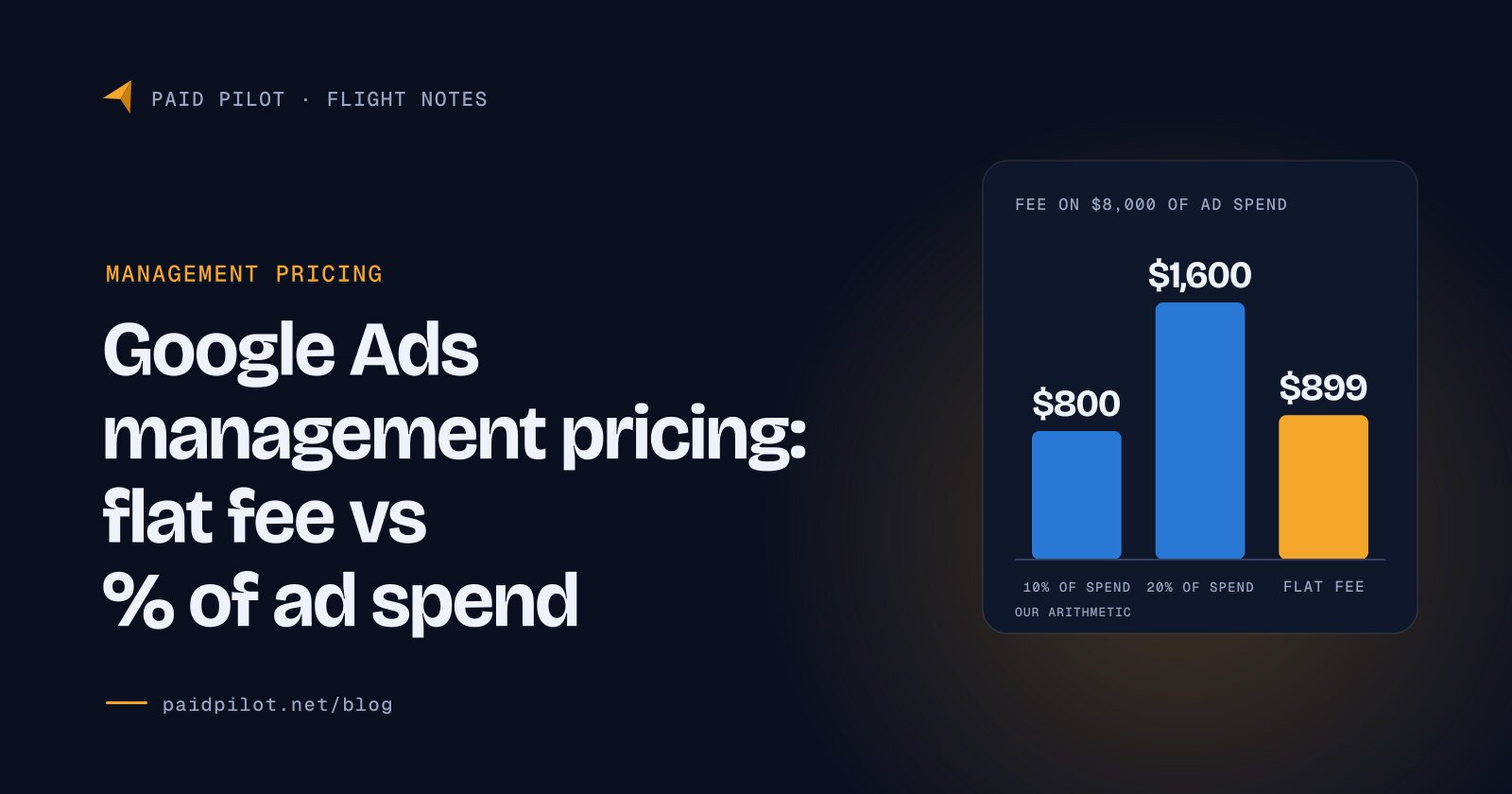
On a small budget, a pure percentage fee looks cheaper on paper, but minimum fees usually erase the difference; as spend grows, a flat fee usually costs less. The crossover depends on the rate and the flat fee, so run the numbers at your real budget and at the budget you hope to reach in a year.
To make this concrete, we applied five published price lists to two budgets: $4,000 and $20,000 a month in ad spend. These are list prices from each provider’s own page on the date shown in the sources; quotes can differ.
Monthly management fee at two ad budgets
Published US price lists applied to $4,000 and $20,000 of monthly Google Ads spend, October 2026 (our arithmetic)
- $4,000 ad spend
- $20,000 ad spend
See the data
| Provider | Fee at $4,000 spend | Share of spend | Fee at $20,000 spend | Share of spend |
|---|---|---|---|---|
| WebFX | $750 | 18.75% | $3,000 | 15% |
| Straight North | $1,000 | 25% | $3,000 | 15% |
| Emprise Digital | $1,000 | 25% | $2,000 | 10% |
| SaaSHero | $1,250 | 31.25% | $1,750 | 8.75% |
| Paid Pilot | $899 | 22.5% | $1,499 | 7.5% |
Two things stand out. At $4,000 a month, every list we checked charges between 18.75% and 31.25% of spend, because minimums and flat fees weigh heavily on a small budget. At $20,000, the percentage models charge 15% while the flat models charge 7.5% to 10% (our arithmetic). If you expect to scale, ask what the fee will be at double your current budget before you sign.
The incentive question also matters. With a percentage fee, cutting wasted spend lowers the agency’s income. That does not mean percentage agencies waste money, but it is a fair question to ask: how do you get paid when you recommend spending less?
Are setup fees normal, and how much are they?
Setup or onboarding fees are common but not universal. Published one-time fees we found run from $0 to $5,800, usually tied to building campaigns and tracking in the first month.
One-time setup or build fees on published price lists
US Google Ads management providers, list prices as published, 2025 to 2026
See the data
| Item | Value |
|---|---|
| WebFX Enterprise | $5,800 |
| WebFX Pro | $2,250 |
| Emprise Digital | $2,000 |
| SaaSHero | $1,000 to $2,000 |
| WebFX Lite | $1,200 |
| LYFE Marketing | $300 |
| Paid Pilot | $0 |
A setup fee is reasonable when real work sits behind it: conversion tracking, call tracking, a clean campaign structure and landing page fixes. OuterBox puts it well: “The setup fee should be tied to a concrete deliverable” (OuterBox, January 2026). Ask for that list in writing, and ask who owns what is built if you leave.
What should a Google Ads management fee include?
At a minimum, the fee should cover ongoing optimization, conversion tracking that works, and regular reporting that shows Google’s real cost. Google sets some of these rules itself for third-party partners.
Google’s transparency requirements for third parties say that if you are charged a management fee separate from the cost of Google Ads, the partner must clearly inform you, in writing before the first purchase, and show the fee on invoices. Where a monthly performance report is part of the deal, it must include costs, clicks and impressions, reporting “the exact amount charged by Google, exclusive of any fees that you charge.” Partners must also give you your customer ID when you ask.
Beyond Google’s rules, in our experience a fair monthly scope for a small business account should include:
- Search term and negative keyword reviews, so you stop paying for irrelevant searches.
- Bid, budget and campaign setting changes, including checks on automated features such as AI Max for Search.
- Ad copy and asset testing, with results you can see.
- Conversion and call tracking, because a fee is only worth judging against leads you can count.
- A plain report and a call that explain what changed, what it cost and what happens next.
Watch for add-ons that quietly raise the real price. WebFX, for example, lists call-tracking number pools at $100 a month for 25 numbers and landing page performance testing at $1,800 as separate add-ons (WebFX). Extras are not wrong, but compare total monthly cost, not headline fees.
Who should own your Google Ads account?
You should. The account should be in your business’s name, with your payment method, and you should hold Admin access. Then you can change agencies without losing your history, conversion data or ads.
Google’s access levels page explains why Admin matters: only Admin users can give account access, change access levels, and unlink manager accounts. Agencies normally work through a manager account (MCC). A manager can also be made the account’s owner, which gives it “full administrative access” and the ability to transfer ownership, while users on your side cannot turn off that ownership without unlinking the manager (Google Ads Help). The client account “still owns its data,” and a user with admin access to either account can unlink the two (Google Ads Help).
One billing detail is easy to miss: if the agency’s manager account pays Google on monthly invoicing, Google says “the account will stop serving after you unlink it” (Google Ads Help). Paying Google directly with your own card or invoice avoids that gap.
Google launches its third-party policy, including written disclosure of management fees and giving customers their customer IDs (Google).
Google adds penalties for third-party partners that enable significant or sustained policy violations, including removal from programs such as Google Partners (PPC Land, October 2024).
Google says it may pause an individual account linked to a manager account that violates the third-party policy; ads serve again only after you unlink (Google, Search Engine Land).
That 2025 change turns ownership into a practical risk, not just a principle. If your agency’s manager account gets into trouble, your campaigns can stop even if you did nothing wrong, and you need Admin access to unlink and get running again.
Agency, freelancer or in-house: how do the costs compare?
A freelancer usually costs least per hour, an agency costs more but brings a team and process, and an in-house hire only makes sense when the workload fills a full-time role. The table below sets the published numbers side by side.
| Option | Published figure | What it covers | Source and date |
|---|---|---|---|
| Freelancer (marketplace) | $20 to $45 an hour | PPC specialists hired through Upwork | Upwork, accessed October 2026 |
| US PPC agency (hourly) | $151.88 an hour | Average US PPC agency rate in an older survey | Credo, updated June 2022 |
| Agency (monthly) | $500 to $2,000 a month | Typical flat fee, small and mid-sized clients | AgencyAnalytics, July 2025 |
| In-house employee | $78,760 a year | US median wage for market research analysts and marketing specialists, the BLS group that includes search marketing strategists | O*NET, BLS 2025 wage data |
Salary excludes payroll taxes, benefits, software and training. The Credo survey is older than our usual 18-month window and is shown for context only.
For most small businesses spending a few thousand dollars a month, a full-time hire is far more than the account needs. Hopkins suggests that businesses with budgets under $2,500 a month consider in-house management or automation tools, since agency fees can eat too much of the budget (Search Engine Journal). That is honest advice worth weighing before you hire anyone.
What contract terms and red flags should you watch for?
The biggest red flags are long lock-ins, an account you do not own, hidden fees and promises Google itself says no one can make.
Minimum terms are widespread. In Credo’s older agency survey (page updated June 2022), 30.52% of PPC firms required a 6 to 12 month minimum engagement and 26.3% had no minimum contract length (Credo). Several 2026 price lists now advertise month-to-month terms with 30 days notice, including Emprise Digital and SaaSHero.
It’s not possible to guarantee a specific ad position on Google.com search results pages.
Google, Advertiser guide: Working with third parties
- You get Admin access to an account in your name. Google’s advertiser guide says the agency must set up a separate Ads account for you.
- Fees are in writing and separate from ad spend. Google tells advertisers to get an official copy of the agreement in writing and to understand the total cost, including partner fees.
- Reports show clicks, impressions and Google’s exact cost. Google calls this the minimum you are owed.
- No guaranteed top position. Guaranteeing top placement is listed as a false or misleading claim in Google’s third-party policy.
- No claimed special deal with Google. Claims of exclusive ad prices or a special relationship with Google are also prohibited; if a firm shows a Partner badge, click it to check the profile.
- A notice period you can live with. Month to month with 30 days notice appears on several current published price lists; anything longer needs a good reason.
A Google Partner badge is worth checking, but it is not a price guarantee. Google’s requirements focus on a 70% optimization score, $10,000 in managed spend over 90 days, and certifications (Google Ads Help). It tells you a firm meets those thresholds, not what it will charge you or how it treats account ownership.
How do you compare two Google Ads management quotes?
Convert every quote into the same two numbers: total first-year cost at your budget, and the true cost per lead once the fee is included. A cheap headline fee with a big setup charge and a 12 month term can cost more than a higher monthly fee you can cancel.
$5,000
ad spend plus fee
60
leads
$83.33
true cost per lead
In this illustration, a business spends $4,000 on clicks and pays a $1,000 fee. At the 2026 median cost per lead of $66.69 for US search campaigns, $4,000 buys about 60 leads, and the fee adds about $16.67 to each one (our arithmetic). Your own cost per lead will differ by industry and market; the budget, CPA and ROAS calculator lets you plug in your numbers.
- Write down your current monthly ad spend and where you expect it to be in 12 months.
- Calculate each quote’s monthly fee at both budgets, including minimums and percentage steps.
- Add one-time fees and paid add-ons such as call tracking or landing pages.
- Multiply by the minimum term to get the committed cost if things do not work out.
- Confirm account ownership and Admin access in writing before anything else.
- Ask how results will be measured: which conversions count, and how phone calls are tracked.
How does Paid Pilot price Google Ads management?
Paid Pilot uses flat monthly fees set by ad budget band: $499 for budgets up to $3,000, $899 for $3,000 to $10,000, and $1,499 for $10,000 to $25,000, with a custom flat fee above that. There is no setup fee, plans are month to month with 30 days notice, and the campaigns are built in your own Google Ads account, which you keep. Google bills your ad spend directly to you. See the full pricing page, or start with a free recorded audit of your current account if you already run ads. If your account needs repair first, our account audit and rescue service covers that.
Frequently asked questions
Most published sources put it at 10% to 20% of monthly ad spend, usually with a minimum fee. AgencyAnalytics gives 10% to 20% for Google Ads (July 2025), and Straight North publishes $1,000 or 15% of the media budget, whichever is greater. Some pages list wider ranges, such as LYFE Marketing’s 12% to 30%.
It depends on your budget and plans. On published price lists we compared, flat fees were a smaller share of spend at $20,000 a month (7.5% to 10%) than percentage models (15%). A flat fee also removes the incentive to raise your spend. On small budgets, minimum fees make both models expensive relative to spend.
A setup fee can be fair if it pays for specific work such as conversion tracking, call tracking and a new campaign build. Published fees range from $0 to $5,800. Ask for a written list of what the fee covers and confirm that everything built stays in your account if you leave.
You should. Keep the account in your business name, pay Google with your own payment method, and hold Admin access. Since June 2025, Google may pause accounts linked to a manager account that breaks its third-party policy, and you need Admin access to unlink and restart your ads.
Upwork lists PPC specialists on its platform at $20 to $45 an hour (accessed October 2026). Experienced independent consultants often charge more; OuterBox gives a planning range of about $75 to $250 or more per hour for hourly consulting. Hourly billing works best for defined projects like an audit or a rebuild.
Sometimes not. If you spend $1,500 a month on clicks, a $1,000 fee adds 67% to your cost. A Search Engine Journal column suggests budgets under $2,500 a month consider in-house management or automation tools. Compare the fee to the extra leads you expect, using your true cost per lead.
Sources
- PPC Agency Pricing: How Much To Charge for PPC Management in 2025, AgencyAnalytics, 17 July 2025.
- PPC Pricing: How Much Does PPC Cost in 2026?, WebFX, 28 September 2026.
- PPC Management Pricing, Straight North, accessed 19 October 2026.
- PPC Management Pricing: Flat Fee vs Percent of Spend, With Our Exact Rates Published, Emprise Digital, 11 June 2026.
- Google Ads Management Pricing: 2026 Complete Guide, SaaSHero, 4 April 2026.
- PPC Pricing: How Much Does PPC Cost in 2026?, LYFE Marketing, 17 December 2025.
- Ask A PPC: How Much Should PPC Management Cost?, Search Engine Journal (Navah Hopkins), 26 April 2025.
- PPC Management Pricing: How Much Do Google Ads Management Services Cost in 2026?, OuterBox, 11 January 2026.
- PPC Advertising Specialists cost, Upwork, accessed 19 October 2026.
- Average PPC Agency Rates, Credo, 28 June 2022.
- PPC Pricing: How Much Do PPC Services Cost?, Credo, 28 June 2022.
- National Wages: Search Marketing Strategists (13-1161.01), O*NET OnLine, BLS 2025 wage data, accessed 19 October 2026.
- Google Ads Benchmarks 2026: Competitive Data and Insights for Every Industry, WordStream by LocaliQ, 16 September 2026.
- Google Ads: Definition, Google Ads Help, accessed 19 October 2026.
- Transparency requirements, Google Advertising Policies Help, accessed 19 October 2026.
- Third-party policy update coming soon, Google Advertising Policies Help, 2014.
- Advertiser guide: Working with third parties, Google Advertising Policies Help, accessed 19 October 2026.
- Third-party policy: False, misleading, or unrealistic claims, Google Advertising Policies Help, accessed 19 October 2026.
- Update to Google third-party policy (June 2025), Google Advertising Policies Help, 6 June 2025.
- Google Ads may pause your account for manager violations, Search Engine Land, 9 June 2025.
- Google tightens rules for Ad Agencies managing client accounts, PPC Land, 14 October 2024.
- About access levels in your Google Ads account, Google Ads Help, accessed 19 October 2026.
- About ownership of client accounts, Google Ads Help, accessed 19 October 2026.
- About unlinking accounts from your manager account, Google Ads Help, accessed 19 October 2026.
- How to become a Google Partner or Premier Partner, Google Ads Help, accessed 19 October 2026.