Short answer
Google Ads for HVAC works best as two tools run together: Local Services Ads for pay-per-lead calls, and Search campaigns for the repair, replacement and maintenance jobs you choose. In LocaliQ’s home services data (April 2024 to March 2025), the median cost per lead on Search was $127.74 for air conditioning and $129.02 for heating.
A sensible start is about 20 leads a month, roughly $2,555 at that median (our arithmetic). Track every call and shift budget with the seasons.
Key takeaways
- HVAC clicks cost more than average. The median cost per click was $9.68 for air conditioning and $9.30 for heating in LocaliQ’s home services benchmarks, against $5.42 across all industries in WordStream’s 2026 benchmarks (different 12-month periods).
- An HVAC lead costs nearly twice the all-industry median. $127.74 to $129.02 per HVAC lead versus $66.69 for all industries, about 1.9 times (our arithmetic).
- Local Services Ads are moving into Google Ads. HVAC is in the first phase, which began in August 2026, and past performance reports do not carry over (Search Engine Roundtable).
- Call-only ads are being retired. No new ones since January 2026, and all stop serving in February 2027 (Google Ads Developer Blog).
- Heat pump tax credit copy may be out of date. The IRS says the federal home improvement credit covers property placed in service before December 31, 2025 (IRS).
How much does Google Ads cost for an HVAC company in 2026?
Expect to pay around $9 to $10 a click and close to $130 a lead on Google Search. LocaliQ’s home services benchmarks, updated July 15, 2026, cover 3,211 US home services search campaigns from April 1, 2024 to March 21, 2025 (LocaliQ).
$9.68
median cost per click, air conditioning installation and repair
$9.30
median cost per click, heating and furnaces
$127.74
median cost per lead, air conditioning
$129.02
median cost per lead, heating and furnaces
Source: LocaliQ, Home Services Search Advertising Benchmarks, US campaigns, April 2024 to March 2025.
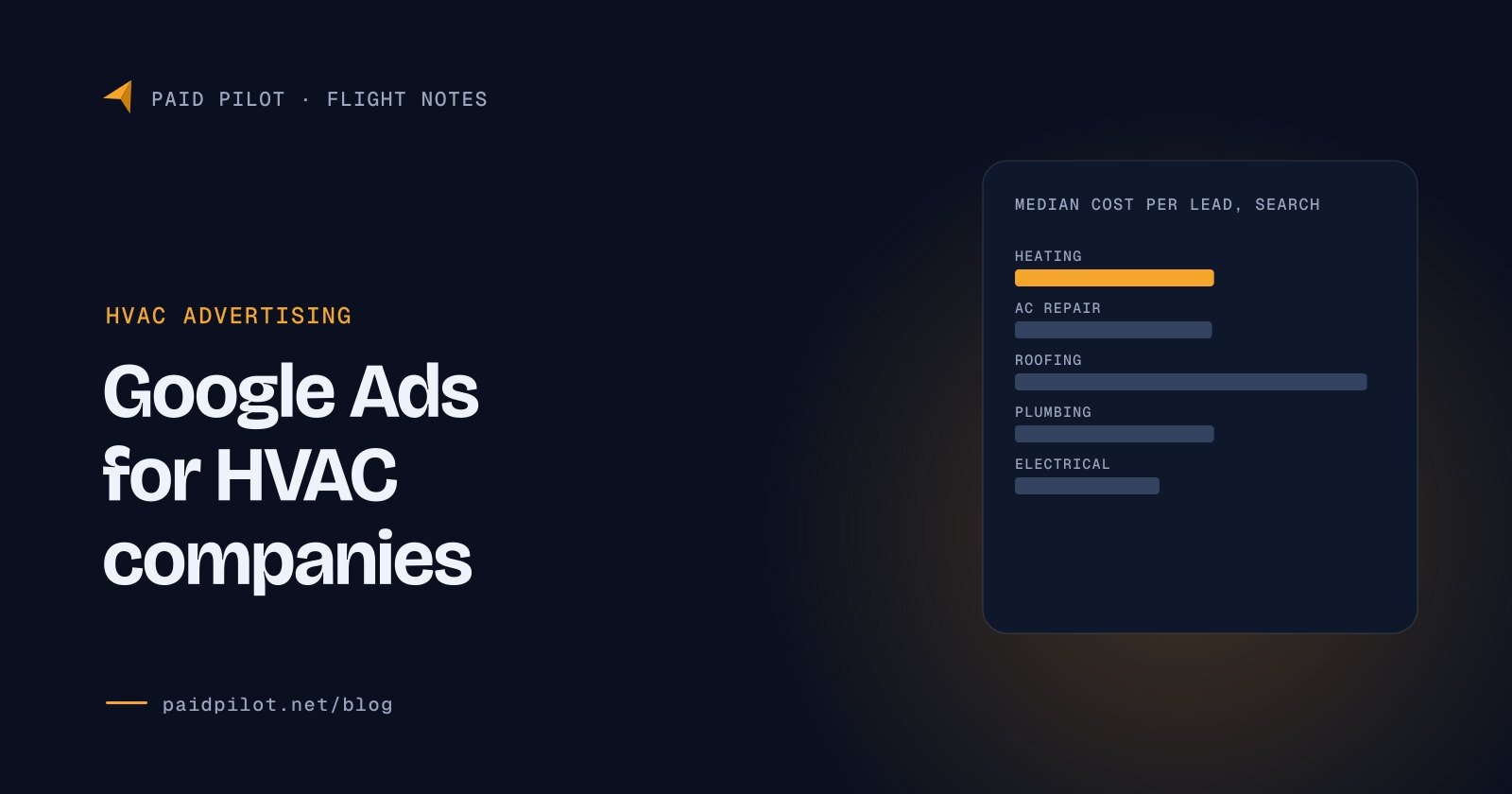
Median cost per lead on Google Search, by home services trade
US search campaigns, April 2024 to March 2025
- HVAC
- Other home services
See the data
| Trade | Cost per click | Conversion rate | Cost per lead |
|---|---|---|---|
| Roofing and gutters | $10.70 | 3.70% | $228.15 |
| Heating and furnaces | $9.30 | 7.48% | $129.02 |
| Plumbing | $10.49 | 7.63% | $129.02 |
| AC installation and repair | $9.68 | 6.56% | $127.74 |
| Landscaping | $8.76 | 6.42% | $117.92 |
| Electricians | $12.18 | 9.08% | $93.69 |
| Handyman services | $7.10 | 13.45% | $54.05 |
For a wider view, WordStream’s 2026 Google Ads benchmarks (13,474 US search campaigns, April 1, 2025 to March 31, 2026) put the Home and Home Improvement category at a median $8.33 per click and $90.92 per lead, against $5.42 and $66.69 across all industries (WordStream by LocaliQ). That category covers far more than HVAC, so the HVAC rows are the closer guide.
| Benchmark | Period | Click-through rate | Cost per click | Conversion rate | Cost per lead |
|---|---|---|---|---|---|
| AC installation and repair (LocaliQ) | Apr 2024 to Mar 2025 | 6.43% | $9.68 | 6.56% | $127.74 |
| Heating and furnaces (LocaliQ) | Apr 2024 to Mar 2025 | 5.97% | $9.30 | 7.48% | $129.02 |
| Home and Home Improvement (WordStream) | Apr 2025 to Mar 2026 | 6.47% | $8.33 | 8.05% | $90.92 |
| All industries (WordStream) | Apr 2025 to Mar 2026 | 6.64% | $5.42 | 8.18% | $66.69 |
All figures are medians. The two reports cover different 12-month periods, so read the gaps as rough, not exact. Sources: LocaliQ, WordStream by LocaliQ.
How much should you budget for Google Ads for HVAC?
Start from the number of leads your team can handle, not from a round dollar figure. Multiply the leads you want each month by a realistic cost per lead, then check that your close rate and average job value cover it.
20
leads a month
$127.74
median AC cost per lead
$2,555
starting monthly budget
This is an illustration, not a quote. If you closed, say, one in three of those 20 leads, you would book about 7 jobs, so the ads would cost roughly $365 per booked job (our arithmetic: $2,555 divided by 7). A replacement job can carry a far higher cost per lead than a tune-up, which is why the sections below budget them separately.
Budget also has to match crew capacity. If your technicians are booked two weeks out, extra spend mostly buys calls you cannot serve, and in Local Services Ads a missed call can count against you. For the wider picture across industries, see how much Google Ads costs for a small business.
Should HVAC companies use Local Services Ads, Search ads, or both?
Most HVAC companies are better served by both. Local Services Ads charge per lead rather than per click and rank you partly on reviews and responsiveness. Search ads charge per click but let you choose keywords, ad copy, landing pages and job types.
How Local Services Ads charge for HVAC leads
Google charges for a lead when you answer a call or call the customer back and speak with them, when you receive a message, voicemail or booking request, and when you miss a call during business hours and the caller stays on the line for more than 20 seconds (Local Services Help, How leads work). Spam, duplicates and follow-up contact from the same customer within 15 days are not charged again, and Google says lead prices may vary by location, job type, lead type and bidding mode.
Ranking depends on your bid, how likely you are to produce a lead, and profile quality. Google lists “your rating, number of reviews, average response time, use of high-quality images” as part of profile quality and warns that “missed calls may negatively affect your responsiveness” (Local Services Help, About ad rankings). For an HVAC shop, answering the phone in peak season is part of the ad strategy.
Google has also folded its old badges into one Google Verified badge. Advertisers who complete Local Services screening and verification receive it, and the money back guarantee that came with the Google Guarantee badge covers only services booked before December 7, 2025 (Local Services Help, About Google Verified badge). Remove any ad or page copy that still promises the guarantee.
Local Services Ads are moving into Google Ads
Google is moving Local Services Ads into the main Google Ads platform as a Performance Max campaign type built for pay-per-lead goals, still shown only on Google Search and Maps. The first phase began in August 2026 for selected US home and storefront service advertisers, including HVAC, and service-area businesses without storefronts follow in late 2026 (Search Engine Roundtable, July 21, 2026).
Manual bidding goes away, weekly budgets become daily budgets, and past campaign reports do not migrate, while lead history does. Google’s Ads Product Liaison recommended that advertisers download their historical data before their transition date (PPC Land, July 20, 2026). Our guide to the Local Services Ads Performance Max migration walks through the steps.
Search campaigns stay keyword based, so they remain the place to target specific work such as heat pump installation. If AI Max for Search is on, read the search terms report weekly.
How should you split emergency, replacement and maintenance searches?
Give each intent its own campaign or ad group, because the searcher, the urgency and the value of the job all differ. A 2026 column for HVACR contractors in ACHR News recommends separate emergency repair and system replacement campaigns with different bidding goals (ACHR News, February 21, 2026).
| Intent | Example searches | Landing page | When to run it |
|---|---|---|---|
| Emergency repair | ac not working, furnace repair near me, no heat | Repair page with a tap-to-call button | Hours you can answer and dispatch |
| Replacement and installation | new ac unit cost, heat pump installation, furnace replacement | Replacement page with a quote form | Year round, heavier in peak seasons |
| Maintenance | ac tune up, furnace maintenance plan | Tune-up or membership page | Spring and fall shoulder seasons |
| Commercial | commercial hvac service, rooftop unit repair | Commercial services page | Weekday business hours |
An illustration of how we structure accounts, not data. Adjust it to the services and hours you actually offer.
Set your service area to Presence
Google’s default location option, Presence or Interest, can reach people who have only shown interest in your area. The Presence option limits ads to “people in or regularly in your targeted locations” (Google Ads Help, About advanced location options). For a trade that drives to the customer, Presence is usually the safer choice, with the radius or ZIP codes matched to where your trucks actually go.
How do you handle heating and cooling seasons?
Shift budget and messaging with the weather instead of running the same ads all year. Cooling demand reaches almost every market: 88% of US households used air conditioning in 2020, including 93% in the South and 92% in the Midwest, but 73% in the West, according to the U.S. Energy Information Administration (EIA, May 31, 2022).
In our experience, repair searches jump with the first heat wave and the first cold snap. Check Google Trends for your state to see when peaks usually start, and move budget toward repair a week or two ahead.
Smart Bidding already adjusts to normal seasonal swings. Google describes seasonality adjustments as a tool for expected conversion rate changes that is ideal for short events of one to seven days, and says they may not work as well for periods longer than 14 days (Google Ads Help, About seasonality adjustments). That makes them a fit for a forecast heat wave or a short promotion, not for the whole summer.
Use an ad schedule to match ads to the hours you can answer. Campaigns show ads all day by default (Google Ads Help, About ad scheduling), so if nobody picks up at 2 a.m., an emergency campaign running then pays for clicks that become missed calls.
Which negative keywords should an HVAC account start with?
Start by blocking job seekers, do-it-yourself searches, parts shoppers and services you do not offer. Google says negative keywords “won’t match to close variants or other expansions,” so you need to add singular, plural and synonym versions yourself (Google Ads Help, About negative keywords).
- Jobs and training: jobs, hiring, salary, apprentice, school, course, certification.
- Do it yourself: how to, diy, manual, wiring diagram, youtube.
- Parts and supply: parts store, wholesale, supply house, filters for sale.
- Services you do not offer: car ac, auto ac, refrigerator repair, window unit, if they are not services you sell.
- Low intent (test before blocking): free, used, salvage. Some markets still convert on these, so check your search terms first.
Treat that list as a starting point and review the search terms report weekly. Our free negative keyword generator builds a starter list from the services you offer.
How should HVAC companies track phone calls from Google Ads?
Count calls as conversions, set a minimum call length that filters out wrong numbers, and import booked jobs if your software allows it. Google Ads can count calls from ads through call and location assets, calls to a Google forwarding number shown on your website, clicks on your number on mobile, and calls you import from another system (Google Ads Help, About phone call conversion tracking). Calls from ads and website calls need Google forwarding numbers with call reporting turned on.
Call-only ads are being retired. Google stopped the creation of new call-only ads from January 2026, and all call-only ads will stop serving in February 2027 (Google Ads Developer Blog, October 9, 2025). Move phone-first campaigns to responsive search ads with call assets now, so you are not rebuilding them in the middle of winter.
If you run Local Services Ads and Search together, tag every caller in one place so you can compare cost per booked job, not just cost per lead. Our Google Ads audit checklist covers the tracking checks to run first.
What changed for HVAC advertisers in 2026?
Four kinds of change affect HVAC ads and landing pages this year: the Local Services Ads platform and badge, call-only ads, the federal heat pump tax credit and refrigerant rules.
Google announces that call-only ads will be retired in favor of responsive search ads with call assets (Google Ads Developer Blog).
The Google Guarantee money back guarantee covers only services booked before December 7, 2025, as Google moves to one Google Verified badge (Local Services Help). The federal Energy Efficient Home Improvement Credit, up to $2,000 a year for qualified heat pumps, covers property placed in service before December 31, 2025 (IRS).
Advertisers can no longer create new call-only ads (Google Ads Developer Blog).
EPA finalizes changes that remove the January 1, 2026 installation deadline for residential and light commercial AC and heat pump equipment using refrigerants above 700 GWP, if it was manufactured or imported before January 1, 2025 (ACHR News).
Google renames its Local Services platform policies as Local Services Ads requirements (TechWyse, June 9, 2026).
Local Services Ads start moving into Google Ads, with HVAC in the first phase (Search Engine Roundtable).
All call-only ads stop serving (Google Ads Developer Blog).
What to do with this: update any ad, asset or landing page that still promises the federal heat pump credit on new installs, describe refrigerant options accurately when customers ask about R-410A equipment, and remove any money back guarantee wording. Confirm state and utility rebates before you advertise them. None of this is tax advice.
Google Ads for HVAC: a checklist for this week
- Export your Local Services history. Past campaign reports do not carry over to Google Ads after migration.
- Answer every ad call during business hours. Missed calls can hurt your Local Services ranking, and a caller who waits more than 20 seconds is still a charged lead.
- Set location targeting to Presence. Match the radius or ZIP codes to where your trucks actually go.
- Split repair, replacement and maintenance. Give each its own budget, ads and landing page.
- Replace call-only ads. Rebuild them as responsive search ads with call assets before February 2027.
- Count calls as conversions. Use Google forwarding numbers with call reporting on, and import booked jobs if you can.
- Add negative keywords. Cover jobs, DIY, parts and services you do not offer, with plurals and synonyms.
- Audit your offer copy. Remove expired tax credit claims and guarantee wording Google no longer supports.
How Paid Pilot handles HVAC accounts
Paid Pilot runs Google Ads only, including Local Services Ads and Search, for small businesses in all 50 states. Every plan includes conversion and call tracking setup and weekly optimization, and the Launch plan is $499 a month for ad budgets up to $3,000 (see pricing). You own the Google Ads account and there is no contract. See our home services page or get a free recorded audit of your current account.
Frequently asked questions
There is no single right number. A practical start is the number of leads you can handle multiplied by a realistic cost per lead. At LocaliQ’s median of $127.74 per air conditioning lead (US campaigns, April 2024 to March 2025), 20 leads a month comes to about $2,555 (our arithmetic). Spend less if your crews are booked out, and more once your cost per booked job is profitable.
For most HVAC companies they are worth running alongside Search. You pay per lead rather than per click, and Google ranks you partly on reviews and how quickly you respond. HVAC is in the first phase of the move into Google Ads, which began in August 2026, so export your old reports before your migration and check your budget settings afterward.
LocaliQ’s home services benchmarks put the median cost per lead at $127.74 for air conditioning installation and repair and $129.02 for heating and furnaces, for US search campaigns from April 2024 to March 2025. A good cost per lead for your business is one where the leads that become paid jobs cost less than the profit those jobs bring in.
Bid on the jobs you want, grouped by intent: repair searches such as furnace repair or ac not working, replacement searches such as heat pump installation, and maintenance searches such as ac tune up. Add town names where they help, and block job seeker, DIY and parts searches with negative keywords, including plurals and synonyms.
Not for new ads. Google stopped the creation of new call-only ads from January 2026, and existing call-only ads stop serving in February 2027. Google points advertisers to responsive search ads with call assets, which still drive phone calls and can be tracked as conversions with a Google forwarding number.
The IRS page for the Energy Efficient Home Improvement Credit, last updated April 28, 2026, says the credit applies to qualifying property placed in service on or after January 1, 2023 and before December 31, 2025. If your ads still promise this credit on new installs, update them. State and utility rebates differ, so check those locally. This is not tax advice.
Sources
- Home Services Search Advertising Benchmarks, LocaliQ, 15 July 2026.
- 2026 Google Ads Benchmarks, WordStream by LocaliQ, accessed 2 November 2026.
- How leads work, Google Local Services Help, accessed 2 November 2026.
- About ad rankings, Google Local Services Help, accessed 2 November 2026.
- About Google Verified badge, Google Local Services Help, accessed 2 November 2026.
- Google Local Services Ads Transitioning To Google Ads Platform, Search Engine Roundtable, 21 July 2026.
- Google folds Local Services Ads into Google Ads, cuts historical reports, PPC Land, 20 July 2026.
- Google Local Services Ads Rules Shift Toward Verification First, TechWyse, 9 June 2026.
- The HVACR Guide to Google Ads in 2026, ACHR News, 21 February 2026.
- About advanced location options, Google Ads Help, accessed 2 November 2026.
- Nearly 90% of U.S. households used air conditioning in 2020, U.S. Energy Information Administration, 31 May 2022.
- About seasonality adjustments, Google Ads Help, accessed 2 November 2026.
- About Ad Scheduling, Google Ads Help, accessed 2 November 2026.
- About negative keywords, Google Ads Help, accessed 2 November 2026.
- About phone call conversion tracking, Google Ads Help, accessed 2 November 2026.
- Upgrade your Call-Only Ads to Responsive Search Ads with Call Assets in the Google Ads API, Google Ads Developer Blog, 9 October 2025.
- Energy Efficient Home Improvement Credit, Internal Revenue Service, 28 April 2026.
- EPA Removes R-410A Installation Deadline, ACHR News, 21 May 2026.