Short answer
AI Max for Search is a set of AI settings inside a normal Google Ads Search campaign, not a new campaign type. During September 2026, Google automatically moved campaigns that used the campaign-level broad match setting or automatically created assets into AI Max, with search term matching switched on.
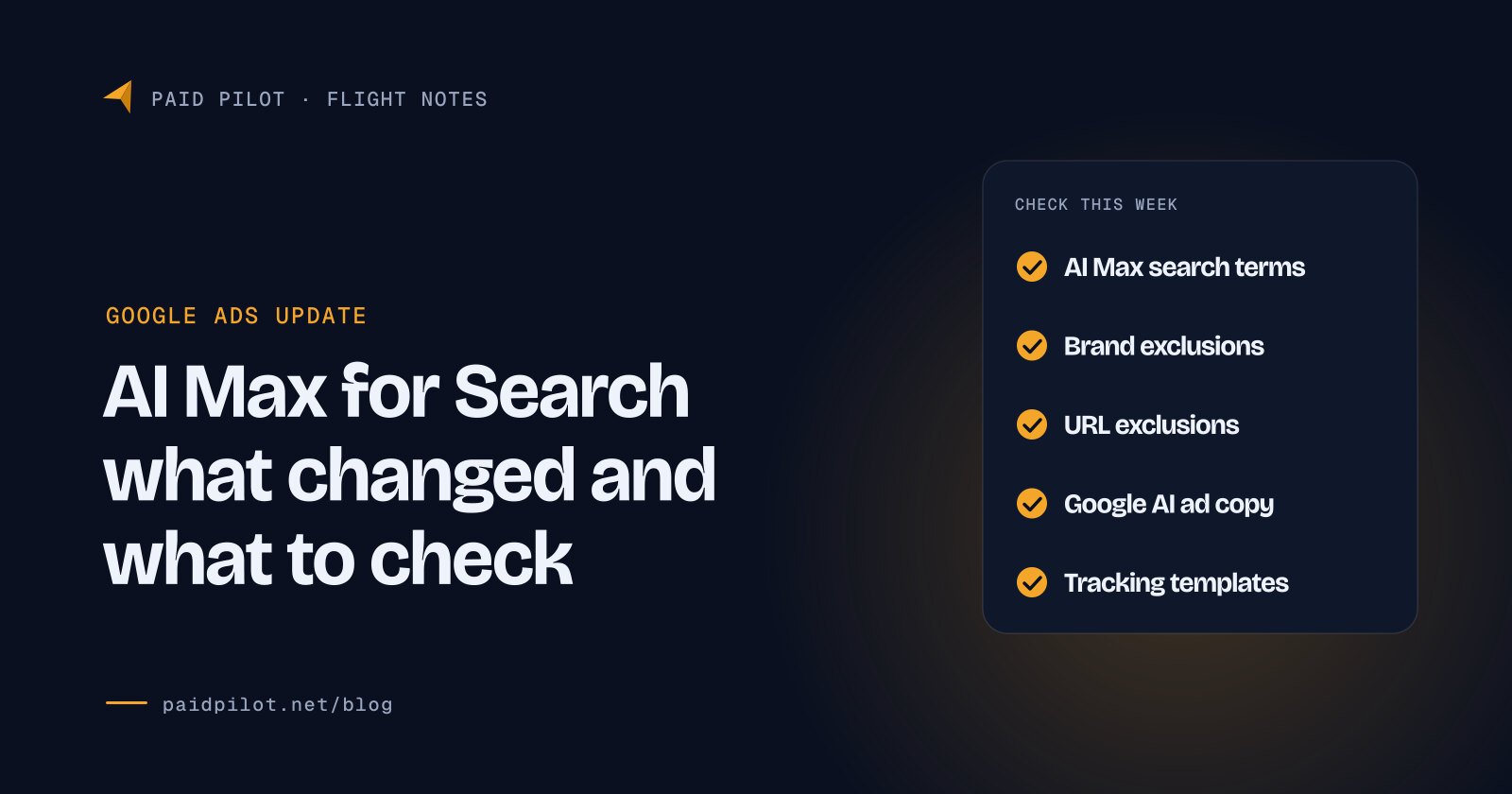
Dynamic Search Ads follow in February 2027. This week, check your search terms report for the AI Max match type, your brand and URL exclusions, and any ad copy Google wrote for you.
Key takeaways
- The upgrade has already happened. Google moved campaign-level broad match and automatically created assets campaigns to AI Max from September 1, 2026 (Google Ads Developer Blog).
- What got switched on depends on what you had. Broad match setting campaigns got search term matching; automatically created assets campaigns also got text customization (Google Ads Developer Blog).
- Your exact and phrase keywords can now reach more searches. In smec’s sample, 80.11% of AI Max impressions came from exact match keywords (Search Engine Journal, March 2026).
- Google’s uplift figures depend on the baseline. Google quoted 14% more conversions or conversion value at a similar CPA/ROAS in May 2025 (Google) and 7% in 2026 data comparing the full feature set with search term matching alone (Google).
- Dynamic Search Ads are next. Their automatic migration runs February 1 to 28, 2027 (Google Ads Developer Blog).
- Turning AI Max off is all or nothing. It disables every AI Max feature, brand exclusions included (Google Ads Help).
What is AI Max for Search?
AI Max for Search is an optimization layer inside an existing Search campaign that matches more searches, writes extra ad text and picks landing pages. In Google’s words, it “isn’t a new campaign type but an optimization layer within existing Search campaigns” (Google Ads Help).
Google released it as a beta in May 2025 (Google). By September 2026, MediaPost reported it was used by “more than 500,000 advertisers” (MediaPost, September 23, 2026).
| Feature | What it does | Where it is set | Can you turn it off? |
|---|---|---|---|
| Search term matching | Uses broad match and keywordless technology to show your ads on searches your keywords do not cover | Campaign, then each ad group | Yes, per ad group |
| Text customization | Writes extra headlines and descriptions from your site, ads and keywords (formerly automatically created assets) | Campaign | Yes, which also turns off final URL expansion |
| Final URL expansion | Sends clicks to the page on your site Google thinks fits the search best | Campaign | Yes |
Source: How AI Max for Search campaigns works and Set up AI Max, Google Ads Help, accessed October 12, 2026.
Two requirements matter for small accounts. Google says the features “need conversion-based Smart Bidding to work effectively”, and search term matching does not work with manual CPC (Google Ads Help). Google also warns that AI Max is “not effective if campaigns are limited by budget” (Google Ads Help).
What changed in your Google Ads account in September 2026?
If a Search campaign used the campaign-level broad match setting or standalone automatically created assets, Google moved it to AI Max in place during September 2026, copying your old setup as closely as it could (Search Engine Roundtable, August 7, 2026). New campaigns have been blocked from using the old settings since August 3, 2026 (Search Engine Land, August 14, 2026).
| Old setting | Search term matching | Text customization | Final URL expansion | When |
|---|---|---|---|---|
| Campaign-level broad match | On | Off | Off | September 2026 |
| Automatically created assets | On | On | Off | September 2026 |
| Dynamic Search Ads | On | On | On | February 2027 |
Sources: Google Ads Developer Blog, August 12, 2026 for the September defaults; Google, updated June 11, 2026 for Dynamic Search Ads.
The second row catches people out. Automatically created assets used to control ad text only; after the upgrade, those campaigns also have search term matching on, which changes which searches trigger your ads (PPC Land, August 6, 2026). Google’s API documentation says that under AI Max “all keywords are treated as broad match by default”, and that turning off search term matching in an ad group restores each keyword’s own match type (Google Ads API docs, updated October 1, 2026).
Existing brand inclusions and exclusions carried over automatically (Search Engine Land). With final URL expansion off, pinned headlines are still respected unless you later turn it on or add URL inclusions (Google Ads Help).
When do Dynamic Search Ads move to AI Max?
Dynamic Search Ads move automatically in February 2027, five months later than first planned. Google Ads Liaison Ginny Marvin said advertisers told Google “you need more time to transition from Dynamic Search Ads (DSA) to AI Max” (Search Engine Land, June 12, 2026).
AI Max for Search launches as a beta (Google).
Google announces the upgrade of Dynamic Search Ads, automatically created assets and campaign-level broad match (Google).
Dynamic Search Ads migration delayed to February 2027 (Search Engine Land).
New legacy broad match and automatically created assets setups blocked (Google Ads Developer Blog).
Those campaigns are upgraded in place through the month (Google Ads Developer Blog).
Reminders go to accounts still running Dynamic Search Ads (Search Engine Land).
Remaining Dynamic Search Ads campaigns migrate; new dynamic ad groups can no longer be created (Google Ads Developer Blog).
You can upgrade earlier yourself: in Campaigns, Settings, select the campaign, open the Dynamic Search Ads panel and choose Upgrade. Dynamic ad groups become standard ad groups, the ads become responsive search ads, and legacy URL rules become read only (Google Ads Help). Google recommends upgrading early so you keep control of the setup (Google).
Does AI Max for Search actually get more leads?
Google’s figures say yes, on average; independent data says results vary a lot by account. Note that Google’s numbers use different baselines, so they are not directly comparable with each other.
14%
more conversions or conversion value at a similar CPA/ROAS, Google, May 2025
27%
for campaigns mostly on exact and phrase keywords, Google, May 2025
7%
full feature set vs search term matching alone, Google internal 2026 data
Sources: Google, May 6, 2025 and Google, updated June 11, 2026. Both figures are for non retail advertisers.
Smarter Ecommerce (smec) looked at more than 250 Search campaigns using AI Max. The median campaign saw conversion value rise 13% and cost per acquisition rise 16%, and only 22% of campaigns landed close to their original ROAS target (Search Engine Journal, March 5, 2026). More volume, often at a higher price per result.
Where AI Max impressions came from, by keyword match type
Share of one million AI Max impressions analyzed by smec, published March 2026
See the data
| Item | Value |
|---|---|
| Exact match | 80.11% |
| Phrase match | 19.52% |
| Broad match | 0.38% |
So the upgrade matters even if you never used broad match: AI Max expansion comes mostly from your exact and phrase keywords. A later smec analysis of 383 million ecommerce impressions in Europe, the Middle East and Africa found the share of exact match impressions expanded by AI Max reached about 29% by July 2026 (PPC Land, August 9, 2026).
Single accounts vary widely. Xavier Mantica published four months of cost per conversion by match type from one account, summarized by PPC Land. It is not a benchmark, but it shows why you should check your own numbers.
Cost per conversion by match type in one advertiser’s account
Four months of data from a single account, reported November 2025
See the data
| Item | Value |
|---|---|
| AI Max | $100.37 |
| Phrase close variants | $97.67 |
| Exact close variants | $61.65 |
| Exact match | $52.69 |
| Phrase match | $43.97 |
Our reading: AI Max can find extra conversions, but do not assume they cost the same as your core keywords. Your own AI Max rows are the only reliable answer.
How do you find AI Max traffic in your reports?
Look for “AI Max” as a match type in the search terms report and for two summary rows at the bottom of the Keywords page. Google lists where each piece now shows up (Google Ads Help; Google Ads Help):
- Search terms report: “AI Max” appears as a match type, with a source column showing broad match expansion or keywordless matching.
- Keywords page: summary rows “Total: AI Max expanded matches” and “Total: AI Max landing page matches”.
- Landing pages report: a “Selected by” column shows pages AI Max chose.
- Asset report: text written by text customization is marked “Google AI” in the “Added by” column. Bulk removal works in Google Ads Editor or the API, not the web interface.
The quickest health check is the share of conversions AI Max produces. Armen Sargsyan suggests adding the two AI Max summary rows and dividing by the campaign total. Using the totals from his five example campaigns (Search Engine Land, September 23, 2026):
21 + 15
AI Max expanded plus landing page match conversions
221
total campaign conversions
16.29%
share of conversions from AI Max
He notes that the search terms report groups part of the activity as “Other search terms” (40% or even 50% in some accounts he has seen), so the summary rows give the better total. Google has also announced a single report linking search term, ad text and landing page, due “later this year” (Google, September 23, 2026).
Which AI Max controls can you still use?
You keep more control than the word “automatic” suggests. These are the levers Google documents, from the most to the least useful for a typical small business account:
- Negative keywords. Google says “negative keywords will be respected even with AI Max turned on” (Google Ads Help). Our Negative Keyword Generator gives you a starting list.
- Search term matching per ad group. Switch it off where you want only your own keywords, such as a brand ad group (Google Ads Help).
- Brand exclusions and inclusions. Exclusions are set per campaign, inclusions per campaign or ad group. Google allows 10 inclusion and 10 exclusion lists per campaign, each with up to 5,000 brands (Search Engine Land).
- Locations of interest. An ad group setting, only available with AI Max, that targets people searching about a place, even on keywordless matches (Google Ads Help).
- URL exclusions and inclusions. With final URL expansion on, exclude pages such as careers or policies; URL inclusions limit an ad group to pages you choose (Google Ads Help).
- Text guidelines (beta). With text customization on, add up to 25 term exclusions and 40 messaging restrictions per campaign (Google Ads Help).
- Experiments. Google’s one click AI Max experiment runs a 50/50 split against your current campaign (Google Ads Help). In August 2026 Google said experiments will support brand and location controls (Search Engine Land).
Be careful with the main AI Max switch. Turning AI Max off disables all of its features, brand exclusions included; turning it back on restores the previous settings (Google Ads Help). To stop only query expansion, switch off search term matching in the ad groups instead.
For comparison, Microsoft Advertising has its own AI Max with the same three features, but presents each as a separate opt in rather than switching search term matching on by default (Search Engine Land, September 1, 2026).
What do advertisers complain about with AI Max?
The common complaints are cost, loss of control over matching, generic ad copy and broken tracking:
- Higher cost per lead on new searches. See the smec and single account figures above.
- Matches you would never have chosen. PPC Land summarized a December 2025 study in which AI Max broadened exact and phrase keywords and sometimes matched brand terms to competing brands (PPC Land).
- Ads that all sound alike. PPC Land asked whether AI written ads will converge on the same wording, noting no one has measured it yet (PPC Land).
- Tracking templates that break. Google says to confirm a dynamic landing page works before enabling AI Max on a campaign with tracking templates (Google Ads Help).
- Hidden search terms. Google withholds some search terms for privacy reasons (Search Engine Land).
Google also advises waiting at least 2 weeks after enabling AI Max before changes such as adding negative keywords (Google Ads Help). In our experience, searches that can never become customers (job seekers, do it yourself questions, services you do not offer) are worth excluding straight away.
What should you check every week after the AI Max upgrade?
Run these ten checks weekly until the AI Max share of your conversions settles. Most take a minute each.
- Confirm what is on. In Campaigns, Settings, open the AI Max section of each Search campaign and note which features are active.
- Read the AI Max rows. In the search terms report, review terms with the AI Max match type. Our Search Term Analyzer speeds up long exports.
- Work out your AI Max share. Use the formula above and compare week to week.
- Compare cost per conversion. Put the AI Max rows next to your exact and phrase keywords. If AI Max costs far more per lead, narrow it.
- Add negatives. Exclude searches that can never become customers.
- Check brand settings. Add competitor names to a brand exclusion list if you do not want to appear on them.
- Review Google AI ad text. Filter assets by “Added by: Google AI”, remove anything inaccurate and add those words to your term exclusions.
- Review landing pages. If final URL expansion is on, check the “Selected by” column and exclude pages that should never get ad traffic.
- Test your tracking. Click a live ad and confirm the landing page loads and conversions still record.
- Check budget and bidding. A limited by budget warning or manual CPC bidding means AI Max cannot work as designed.
Should a small business keep AI Max for Search on?
Keep it on where you have reliable conversion tracking, conversion-based bidding and enough budget, and switch off search term matching where it costs more than your keywords. That is our view, not a Google rule. Navah Hopkins suggests at least 15 to 30 conversions in a 30 day period before relying on search term matching (Search Engine Land).
If you are still working out a budget, our guide to how much Google Ads costs has current benchmarks. Home service businesses should also read about the Local Services Ads move into Performance Max, a separate change happening at the same time.
How Paid Pilot handles this: our Google Search Ads management includes checking which AI Max features are active, reading the AI Max search terms and setting negative keyword, brand and URL controls. To see what the September upgrade changed in your account, request a free recorded audit. Plans start at $499 a month for ad budgets up to $3,000 (pricing); you keep your Google Ads account and there is no contract.
Frequently asked questions
Google has not described an opt out for the September 2026 upgrade. Afterwards you can switch off search term matching in each ad group, turn off text customization, or turn AI Max off for the whole campaign, which disables every AI Max feature including brand exclusions.
It can. Google’s API documentation says that with AI Max on, all keywords are treated as broad match by default. Switching off search term matching in an ad group restores each keyword’s own match type.
Yes. Google’s AI Max help center says negative keywords are respected even with AI Max turned on. Google suggests waiting two weeks after enabling AI Max before making changes, but clearly irrelevant searches are worth excluding right away.
No. AI Max is a set of features inside a Search campaign, while Performance Max is a separate campaign type across Google’s channels. Google says the two can compete in the same auction, and the one with the higher Ad Rank serves.
Search term matching does not work with manual CPC. Google says the AI Max features need conversion-based Smart Bidding, such as Maximize Conversions or Maximize Conversion Value, to work effectively.
They are upgraded automatically in February 2027. You can upgrade earlier from the Dynamic Search Ads panel in campaign settings. Dynamic ad groups become standard ad groups and the ads become responsive search ads.
Sources
- We’re upgrading Dynamic Search Ads to AI Max, Google (The Keyword), 15 April 2026, updated 11 June 2026.
- Introducing AI Max for Search campaigns, Google (The Keyword), 6 May 2025.
- We’re bringing AI Brief to more languages and adding a new AI Max reporting feature, Google (The Keyword), 23 September 2026.
- Migrate Campaign-level Broad Match and Automatically Created Assets to AI Max, Google Ads Developer Blog, 12 August 2026.
- Get started with AI Max for Search campaigns, Google Ads API documentation, updated 1 October 2026.
- How AI Max for Search campaigns works, Google Ads Help, accessed 12 October 2026.
- Set up AI Max for Search campaigns, Google Ads Help, accessed 12 October 2026.
- Frequently asked questions about AI Max for Search campaigns, Google Ads Help, accessed 12 October 2026.
- About reporting in AI Max for Search campaigns, Google Ads Help, accessed 12 October 2026.
- Use text guidelines with Performance Max and Search campaigns (beta), Google Ads Help, accessed 12 October 2026.
- Google sets AI Max migration timeline for Search campaigns, Search Engine Land, 14 August 2026.
- Google to auto-upgrade automatically created assets to AI Max, Search Engine Land, 6 August 2026.
- Google delays Dynamic Search Ads migration to AI Max, Search Engine Land, 12 June 2026.
- Google adds new AI Max testing and planning tools, Search Engine Land, 20 August 2026.
- How much of your Google Ads conversions come from AI Max?, Search Engine Land, 23 September 2026.
- Google vs. Microsoft AI Max: What’s the same and what’s different, Search Engine Land, 1 September 2026.
- On Sep 1 Google Ads To Migrate ACA & Campaign-Level Broad Match To AI Max, Search Engine Roundtable, 7 August 2026.
- What SMEC’s Data Reveals About AI Max Performance, Search Engine Journal, 5 March 2026.
- Google Ads AI Max auto-upgrade lands September 1. Will ads all look alike?, PPC Land, 6 August 2026.
- Exact match loses 1 in 4 impressions to AI Max, smec finds, PPC Land, 9 August 2026.
- Independent tests show AI Max underperforms traditional match types, PPC Land, 8 November 2025.
- Google Ads Enhances AI Max, Enables Unified Reporting, MediaPost, 23 September 2026.