Short answer
If people already search for what you sell, such as a plumber, a dentist or a lawyer, put the first $2,000 into Google Ads, where buyers are asking for you right now. If your product is something people do not know to search for, or buy on impulse or looks, Meta usually wins.
Most service businesses start with Google and add Meta once their search leads are profitable.
Key takeaways
- At the 2026 medians, a Google search lead costs $66.69 and a Meta lead-campaign lead costs $27.39. The studies count leads differently, so treat that as a range, not a race.
- $2,000 buys about 369 Google search clicks, or about 1,111 clicks on a Meta lead campaign. A searcher asked for your service; a scroller did not.
- Google is not always the pricier one: beauty and personal care leads cost $39.25 on Google and $50.91 on Meta.
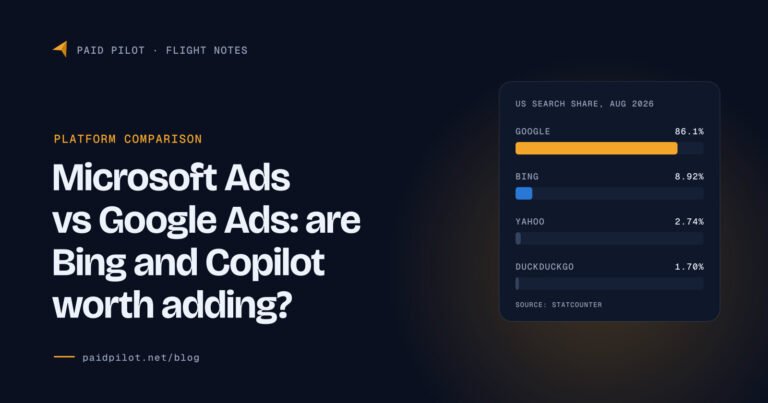
- Google has 86.1% of US search engine market share; Meta’s apps are used by 3.60 billion people a day.
- Meta’s automation needs volume. A $2,000 budget produces roughly 17 Meta leads a week at the median, well below the 50 results a week Meta has long cited for leaving the learning phase.
Google Ads vs Meta Ads: what is the real difference?
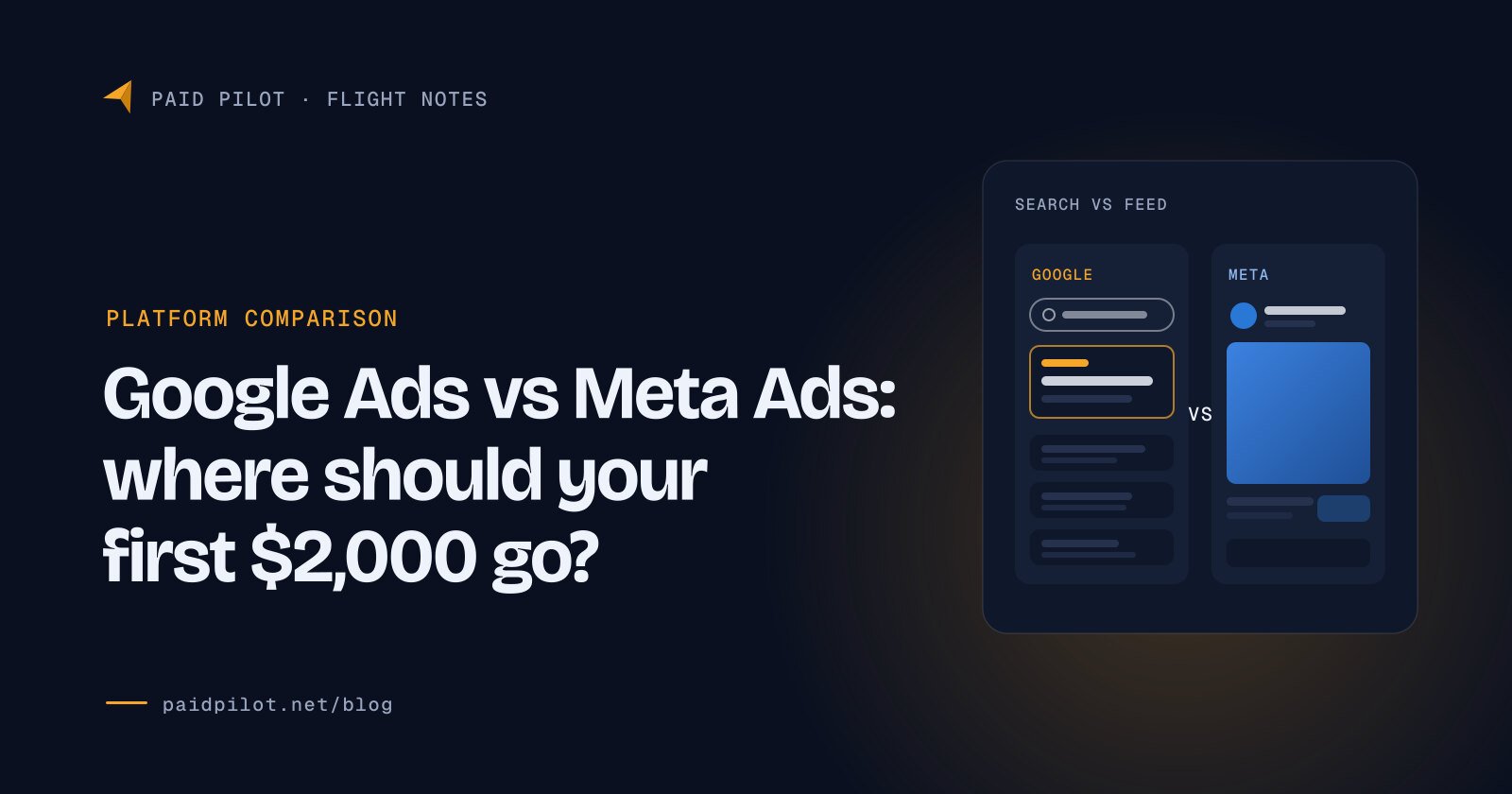
Google Ads puts your ad in front of people who are searching for something, at the moment they search. Meta Ads put your ad into Facebook, Instagram, Messenger and Threads, in front of people chosen by who they are and what they do, while they are doing something else. Marketers call the first demand capture and the second demand creation.
Both platforms are huge. Google handled 86.1% of US searches in August 2026, and says it sees more than 5 trillion searches a year. Meta reported 3.60 billion daily active people across its apps in June 2026. The question is not reach. It is whether your customer is looking for you, or needs to be found.
What does $2,000 buy on Google Ads and Meta Ads in 2026?
The fairest public comparison is WordStream and LocaliQ’s pair of 2026 benchmark reports. The WordStream by LocaliQ Google Ads Benchmarks 2026 covers 13,474 US search campaigns. The WordStream by LocaliQ Facebook Ads Benchmarks 2026 covers US campaigns from April 2025 to June 2026, including 452 lead-generation campaigns and 1,377 traffic campaigns. All figures are medians.
369
Google search clicks for $2,000 at the $5.42 median
30
Google search leads at the $66.69 median cost per lead
1,111
Meta lead-campaign clicks at the $1.80 median
73
Meta leads at the $27.39 median cost per lead
Our arithmetic from the 2026 medians in WordStream by LocaliQ Google Ads Benchmarks 2026 and WordStream by LocaliQ Facebook Ads Benchmarks 2026. Each median comes from a different set of campaigns, so clicks times conversion rate will not exactly equal leads.
| Median, 2026 | Google search | Meta lead campaigns | Meta traffic campaigns |
|---|---|---|---|
| Cost per click | $5.42 | $1.80 | $0.60 |
| Click-through rate | 6.64% | 2.70% | 1.93% |
| Conversion rate | 8.18% | 8.54% | not measured |
| Cost per lead | $66.69 | $27.39 | not measured |
On paper, Meta produces more than twice as many leads for the money. Two things narrow that gap in real life. First, a Meta lead is often an instant form someone tapped through without leaving the app, while a search lead is usually a call or form from someone who went looking. We know of no reliable study comparing close rates, so judge this on your own numbers. Second, the gap is not the same everywhere, as the next chart shows. And search is not automatically the better converter: in Unbounce’s 2024 study of 41,000 landing pages, paid social traffic converted slightly better than paid search (12% vs 10.9%).
Which platform gets cheaper leads in your industry?
Median cost per lead: Google search vs Meta lead campaigns
US campaigns. Google: April 2025 to March 2026. Meta: April 2025 to June 2026.
- Google Ads (search campaigns)
- Meta Ads (lead campaigns)
See the data
| Industry | Google search cost per lead | Meta leads cost per lead |
|---|---|---|
| All industries | $66.69 | $27.39 |
| Home and home improvement | $90.92 | $42.95 |
| Dentists and dental services | $72.97 | $61.56 |
| Physicians and surgeons | $40.04 | $32.14 |
| Real estate | $102.51 | $13.74 |
| Beauty and personal care | $39.25 | $50.91 |
| Attorneys and legal services | $131.63 | not published |
Meta was cheaper per lead in four of the five industries where both studies publish figures, and dramatically so in real estate. Beauty and personal care is the exception. For legal services there is no 2026 Meta lead benchmark, and Google search leads for attorneys are the most expensive of any industry at $131.63, because one case can be worth thousands.
When is Google Ads the better first $2,000?
- People search for what you do. “Water heater repair”, “emergency dentist”, “divorce lawyer near me”: if customers type it, Google can put you in front of them at that moment.
- The need is urgent. Nobody scrolls Instagram hoping to find a plumber while the kitchen floods.
- You serve a defined area. Search campaigns and Local Services Ads target by location precisely, and Local Services Ads charge per lead instead of per click.
- The customer is worth a lot. High-value services can afford a $70 to $130 lead when it is a real enquiry.
- You want control over small budgets. Google has no minimum spend, and never charges more than 30.4 times your daily budget in a month.
That covers most of the businesses we work with: home services, dentists, medical practices and law firms.
When is Meta Ads the better first $2,000?
- Nobody searches for your product yet, because it is new, or people do not know the problem it solves.
- It sells on looks or impulse: clothing, home decor, food, gifts, events.
- You run a local promotion, such as an opening, a seasonal offer or a class, and want the people nearby to know.
- You have a list or website visitors to re-engage. Retargeting past visitors and customers is often the cheapest win on Meta.
- Leads are cheap in your category. Real estate is the clearest case in the 2026 data.
One caution for real estate, lending and hiring: Meta treats housing, credit and employment as special ad categories, which limits the targeting options you can use.
Where should your first $2,000 go? A starting point by business type
This table is our starting point, not a rule. Your own cost per customer should overrule it within a few months.
| Your business | Where the first $2,000 goes | Why |
|---|---|---|
| Emergency and repair trades (plumbing, HVAC, locksmiths, roofing) | Google Search and Local Services Ads | People search the moment something breaks. A feed cannot catch that moment. |
| Dentists and medical practices | Mostly Google Search; test Meta for one specific offer | Patients search for an appointment. Meta leads cost less in the data, so a focused offer is worth a small test. |
| Law firms | Google Search | High-value, high-intent searches, and no 2026 Meta lead benchmark for legal to plan against. |
| Real estate agents | Both: Meta for seller and buyer lead forms, Google for people searching to sell or buy | Meta leads were far cheaper ($13.74 vs $102.51), but housing ads on Meta run with restricted targeting. |
| E-commerce stores | Google Shopping first, Meta for new products and retargeting | Shoppers compare on Google; Meta is where people discover products they did not know to search for. |
| A new product nobody searches for yet | Meta | There is no search demand to capture, so you have to create it. |
| Beauty and personal care | Google Search, then test Meta | The one category in the data where Google leads were cheaper ($39.25 vs $50.91). |
For stores, the data backs a mix. Triple Whale found a median return on ad spend of 3.27 on Google against 1.88 on Meta across thousands of online brands from August 2025 to July 2026, yet the same brands put about two thirds of their ad spend into Meta and about 22.5% into Google. Our reading: stores use Meta to find new customers and Google to catch the ones already comparing. Our e-commerce page explains how we run Google Shopping and Performance Max for stores.
Why a small budget struggles on Meta’s automation
Meta increasingly runs campaigns for you. Its Advantage+ campaigns automate the audience, budget and placements, and Meta told investors in July 2026 that Advantage+ had passed a $75 billion annual revenue run rate, with 9 million small businesses using at least one of its AI creative tools.
Automation learns from results. Meta’s guidance has long been that an ad set needs about 50 optimization events in a week to leave the “learning phase”, the figure that, as Jon Loomer noted in 2024, Meta’s documentation still gives. At the 2026 median of $27.39 a lead, 50 leads a week costs about $1,370 a week, or roughly $5,900 a month (our arithmetic). A $2,000 monthly budget produces around 17 leads a week, so the system may never fully settle. That does not make Meta pointless on $2,000, but it does mean keeping campaigns simple: one audience, one offer, one ad set.
Google’s automated bidding also works best with steady conversion data, which is why we launch small accounts with tightly chosen keywords and add automation as conversions come in.
How to tell which platform actually worked
- Count the same thing on both. A booked job or a paying customer, not a click or a form view.
- Track phone calls. Most local leads call. Without call tracking, Google looks worse than it is.
- Give it 60 to 90 days and at least a few dozen leads per platform before you judge.
- Compare cost per customer: spend divided by the customers who actually paid.
- Ask every new customer how they found you, because some people see a Meta ad and later search on Google.
If you want to know what Google Ads would cost in your market before you spend anything, our free recorded audit estimates it, including an honest answer if Google is not the right place for your first $2,000. For the full cost picture, see how much Google Ads costs in 2026; for other channels, see Microsoft Ads vs Google Ads and ChatGPT ads for small businesses.
Frequently asked questions
Per click, yes: in 2026 the median Meta traffic click cost $0.60, against $5.42 for a search ad click. Per lead the gap narrows to $27.39 on Meta lead campaigns and $66.69 on Google search, and the two count leads differently. Compare cost per paying customer before deciding.
Start where your customers already are when they decide. If people search for what you do, start with Google Ads. If they need to discover you first, or buy on impulse or looks, start with Meta. Most local service businesses start with Google.
You can, but splitting a small budget slows learning on both. At the 2026 medians, $1,000 buys about 15 Google search leads or about 36 Meta leads a month. We suggest proving one channel for 60 to 90 days, then adding the second.
Usually Google, because people search for a plumber, dentist or lawyer at the moment they need one, and Local Services Ads let you pay per lead. Meta works best for local businesses as a second channel for offers, events and retargeting.
Most stores need both. In Triple Whale data for August 2025 to July 2026, the median return on ad spend was 3.27 on Google and 1.88 on Meta, yet the same brands gave Meta about two thirds of their spend, largely to find new customers.
No. Paid Pilot only runs Google Ads, so we are not the right people to run your Meta campaigns. If our audit shows Meta would suit your business better than Google, we will tell you.
Sources
- Google Ads Benchmarks 2026: Competitive Data & Insights for Every Industry, WordStream by LocaliQ, updated 19 May 2026.
- Facebook Ads Benchmarks 2026, WordStream by LocaliQ, 14 September 2026.
- Facebook Ads Benchmarks 2025, WordStream by LocaliQ, 2025.
- Search engine market share, United States, August 2026, StatCounter Global Stats, accessed 30 September 2026.
- AI, personalization and the future of shopping, Google, 3 March 2025.
- Meta Reports Second Quarter 2026 Results, Meta Platforms, 29 July 2026.
- Meta Q2 2026 earnings call transcript, Meta Platforms, 29 July 2026.
- Advantage+ campaigns, Meta for Developers, accessed 30 September 2026.
- Special ad categories, Meta for Developers, accessed 30 September 2026.
- Is the learning phase 10 or 50 events?, Jon Loomer Digital, 14 July 2024.
- How Google Ads works, Google, accessed 30 September 2026.
- Average daily budgets and monthly charging limits, Google Ads Help, accessed 30 September 2026.
- How Local Services Ads charges work, Google Local Services Help, accessed 30 September 2026.
- Google Ads benchmarks, Triple Whale, 20 August 2026.
- Facebook ads benchmarks, Triple Whale, 18 August 2026.
- Small Business Marketing Trends Report 2026, LocaliQ, 24 February 2026.
- Conversion Benchmark Report, Unbounce, 2024.