Short answer
ChatGPT ads are sponsored listings that appear below ChatGPT’s answers for logged-in adults on the Free and Go plans. Since May 2026 any US business can buy them through a self-serve beta, from $25 a day, and OpenAI suggests starting bids of $3 to $5 per click.
For most small businesses the honest answer is not yet. Early click-through rates are around 0.7%, there is no keyword targeting, and reporting is thin. Test them once Google Ads is profitable and your conversion tracking works, with a budget you can afford to learn with.
Key takeaways
- ChatGPT ads started on 9 February 2026 in the US and were available in more than 60 countries by 23 September 2026. Plus, Pro, Business, Enterprise and Edu users see no ads.
- Any business can buy them now: the self-serve Ads Manager beta opened on 5 May 2026, with a $25 minimum daily budget for US dollar accounts.
- Clicks are not cheap. OpenAI recommends starting bids of $3 to $5 per click, close to the $5.42 median for Google search ads.
- Early results are weak on clicks: 0.73% of US ad-bearing exchanges led to a click in Graphite’s analysis of Similarweb panel data, against a 6.64% median click-through rate for Google search ads.
- There are no keywords. Ads are matched to the conversation, your ad and landing page, and “context hints” you write, which OpenAI says are not exact-match keywords.
What are ChatGPT ads?
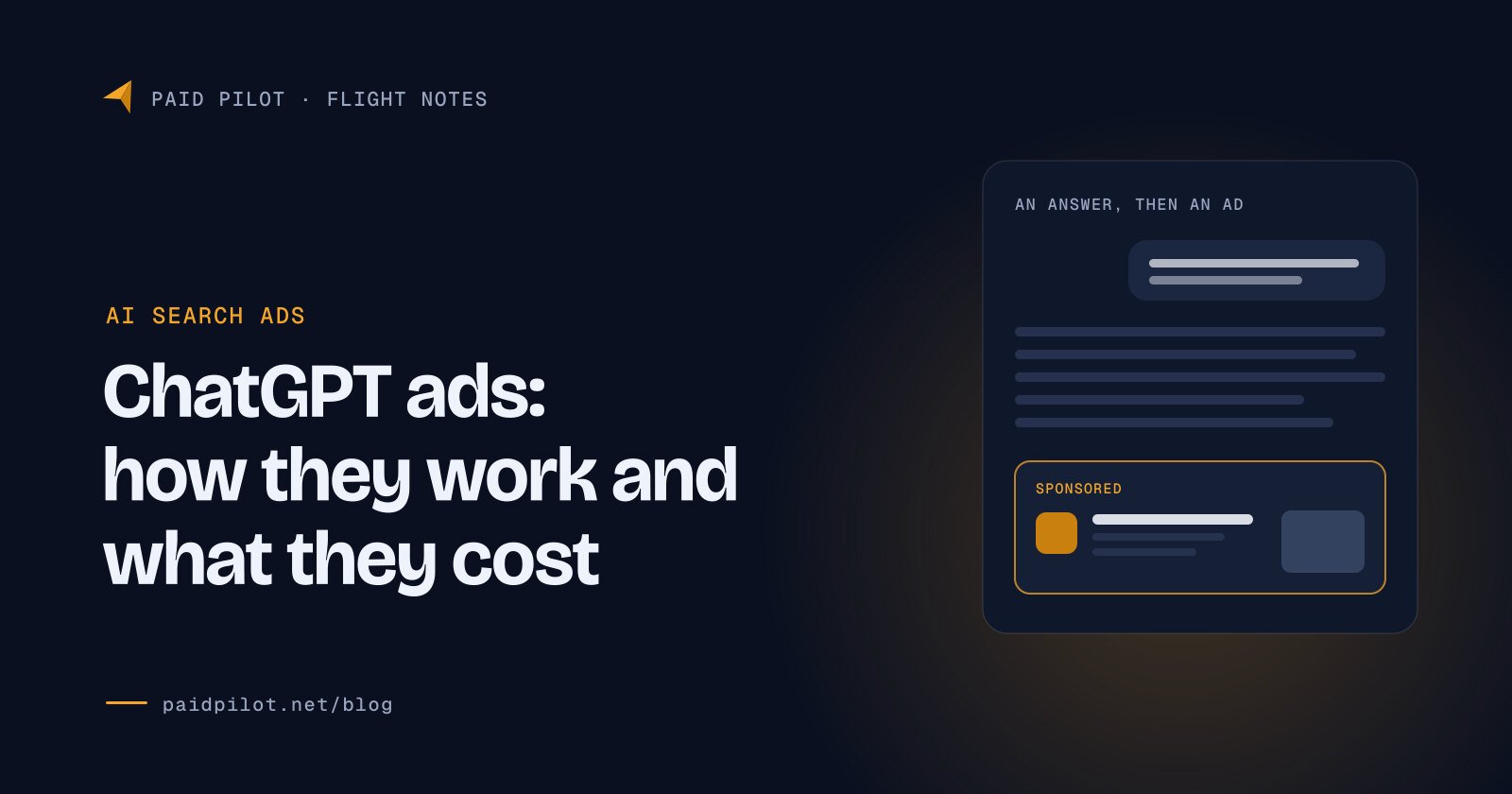
ChatGPT ads are paid placements that businesses buy inside ChatGPT, OpenAI’s AI assistant. According to OpenAI Help Center, ads can appear below the end of a response, are clearly labeled as sponsored and are visually separated from the answer. OpenAI says ads do not influence the answers ChatGPT gives.
Only some people see them: logged-in adults on the Free plan and on Go, OpenAI’s $8 a month plan. Plus, Pro, Business, Enterprise and Edu accounts have no ads. OpenAI does not show ads to users it identifies or predicts as under 18, or next to sensitive topics such as personal health, mental health and politics, and Free users can opt out of ads in exchange for fewer daily messages.
The audience is still huge. OpenAI said ChatGPT had 1.2 billion weekly users on 29 September 2026. Not all of them see ads, though: in March, OpenAI told Reuters that about 85% of users were eligible, but fewer than 20% were shown an ad on a given day.
How do ChatGPT ads work?
The conversation
what the person is asking right now
Your ad
landing page, ad text, context hints and bid
The auction
relevance-weighted, second-price
There are no keywords to bid on. OpenAI says its system looks at the context and intent of the current conversation, your landing page, headline and description, the context hints you write, and, when ads personalization is on, select signals from the person’s wider ChatGPT use. Context hints describe the conversations you want to appear in, but OpenAI warns they are not exact-match keywords and do not guarantee delivery.
Eligible ads then compete in what OpenAI calls a relevance-weighted, second-price auction. In plain English, a more relevant ad can beat a higher bid, and the winner pays roughly what it needed to beat the next ad, not its full bid.
Each ad shows your business name, logo, a headline, a short description, an image and a link to your landing page. Online stores can also run product feed campaigns. Since 16 September 2026, OpenAI has been testing Sponsored Agents with select US advertisers: after seeing an ad, a person can start a separate, clearly labeled conversation with the business’s own agent inside ChatGPT.
Privacy cuts both ways. OpenAI says advertisers do not have access to chats, chat history, memories or personal details, which is good for users. It also means you never see the conversations that triggered your ad. Reports show impressions, clicks, spend, click-through rate, average cost per click and per 1,000 views, and conversions.
When did ChatGPT ads launch? A 2026 timeline
OpenAI announces it will test ads in the US on the Free and Go plans.
The US test begins for logged-in adults on Free and Go.
OpenAI reports no impact on user trust metrics, and Reuters reports the pilot passed $100 million in annualized revenue in six weeks.
A self-serve Ads Manager beta opens with cost-per-click bidding, and the $50,000 minimum is dropped (Axios).
Conversion-optimized campaigns reach advertisers in early access.
Ads are live in the UK, Mexico, Brazil, Japan and South Korea, after Canada, Australia and New Zealand.
OpenAI announces ads in 31 European countries from the following week.
OpenAI says ChatGPT ads passed $1 billion in annualized revenue in under 200 days, with tens of thousands of advertisers.
Sponsored Agents start testing with select US advertisers.
ChatGPT ads are available in more than 60 countries.
How do you buy ChatGPT ads?
Sign up at ads.openai.com. OpenAI suggests one person creates the advertiser account and then invites anyone else who needs access, such as your agency. Choose the country, currency and time zone carefully, because they cannot be changed after the account is created. Billing is by credit card. Then pick one of three objectives:
- Views (CPM): you pay per 1,000 impressions. Built for visibility.
- Clicks (CPC): you pay per click to your website. OpenAI recommends starting bids of $3 to $5.
- Conversions: the system bids toward one standard event you track with OpenAI’s pixel or Conversions API, such as a purchase or a lead. You still pay per impression or per click, and the event cannot be changed once the campaign is created.
Targeting is simpler than Google’s. You must choose a country, and campaigns without a product feed can narrow to states, cities, markets or postal codes where available. You can pick device platforms (Android and iOS apps, mobile web and desktop web) and use custom audiences, which need at least 25,000 matched users to target but can be smaller to exclude. There are no keyword, demographic or in-market audience options, and one agency reports that results can only be broken down by country (Search Engine Land).
How much do ChatGPT ads cost?
$25
minimum daily budget for US dollar accounts
$3 to $5
OpenAI’s recommended starting bid per click
$2 to $5
average cost per click one agency reports
$760
a month at the minimum daily budget
Sources: OpenAI Help Center and OpenAI Help Center; Search Engine Land, 10 August 2026. The $760 is our arithmetic: $25 a day for an average month of 30.4 days.
Prices have fallen fast. At launch, advertisers were reportedly paying up to $60 per 1,000 views and committing hundreds of thousands of dollars. Within three months, reported rates were as low as $15 to $25 per 1,000 views and the minimum commitment was gone.
| When | What was reported | Source |
|---|---|---|
| January 2026 | Up to $60 per 1,000 views | BleepingComputer, citing The Information |
| February 2026 | Pilot minimum spend of at least $200,000 | Adweek |
| April 2026 | Rates as low as $25 per 1,000 views; pilot minimum cut from $250,000 to $50,000 | Digiday |
| April 2026 | Cost-per-click bids of $3 to $5 in Ads Manager | Digiday |
| April 2026 | Rates as low as $15 per 1,000 views | Marketing Brew |
| May 2026 | Self-serve beta opens and the $50,000 minimum is removed | Axios |
| June 2026 | Default maximum bid of $60 per 1,000 views in Ads Manager | MediaPost |
| August 2026 | Average cost per click of $2 to $5; a warning that ads may not deliver below a $3 maximum bid | Search Engine Land |
| September 2026 | Minimum daily budget of $25; recommended starting bids of $3 to $5 per click | OpenAI Help Center |
Clicks from $760 a month, the ChatGPT ads minimum
$25 a day for an average month, at OpenAI’s recommended bids and at the 2026 median for Google search ads.
- ChatGPT ads
- Google search ads
See the data
| Scenario | Cost per click | Clicks for $760 |
|---|---|---|
| ChatGPT ads, low recommended bid | $3.00 | 253 |
| ChatGPT ads, high recommended bid | $5.00 | 152 |
| Google search ads, 2026 median | $5.42 | 140 |
The takeaway: a ChatGPT click costs about the same as a Google search click. What differs is what happens around it. On Google, the person typed exactly what they want and your ad sits next to it. On ChatGPT, your ad follows an answer the person may already be happy with.
Do ChatGPT ads work? What early results show
Click-through rate: ChatGPT ads vs search ads
Three comparisons reported in 2026. The US row pairs two different studies; the other two compare within one advertiser or agency.
- ChatGPT ads
- Search ads
See the data
| Comparison | ChatGPT ads | Search ads | Source |
|---|---|---|---|
| US averages | 0.73% | 6.64% (Google search median) | Graphite via Search Engine Journal; WordStream by LocaliQ |
| One Adthena client | 0.91% | 6.4% (Google search, same sector) | Campaign |
| One Choice OMG campaign | about 0.6% | about 2% (the agency’s usual search ads) | MediaPost |
Click-through rates are the clearest early signal, and they are low. Across nine markets, Graphite found rates between 0.6% and 0.75% in the US, UK, Canada, Australia and New Zealand, and above 1% only in Brazil, Mexico, Japan and South Korea. An Adthena client saw 0.91% against a 6.4% benchmark for Google search in the same sector (Campaign).
Conversions are the bigger question. In one agency’s test described in Search Engine Land, ChatGPT ads converted 0.21% of clicks against 3.71% on Google Ads. OpenAI points to better results: an unnamed ecommerce advertiser earned 3x its ad spend over 28 days, and a technology partner found more than 80% of ad-driven ChatGPT traffic came from new customers. And not every agency report is negative: a buyer at Common Thread Collective told MediaPost that after switching on a new bid strategy, ChatGPT had the highest click-through rate of the three channels they run, ahead of Meta and Google.
The early limits are real. One large advertiser had spent just 3% of a $250,000 budget after several weeks, and Adthena described a reporting glitch that hid advertisers’ own data. Search Engine Land noted in May that inventory was still limited, Digiday wrote that without independent measurement, advertisers are taking OpenAI’s word for results, and buyers told Adweek in September they want brand safety controls, prompt matching and incrementality tracking.
Our view: judge ChatGPT ads on cost per lead or sale, tracked with the pixel or Conversions API. A 0.7% click-through rate is not a verdict on its own, but it means you need a lot of views before you learn anything.
Which businesses cannot advertise on ChatGPT?
OpenAI’s ad policies, updated on 10 September 2026, ban several categories outright and restrict others to the US, case by case:
| Category | Can you advertise? |
|---|---|
| Adult content, including dating apps | No |
| Alcohol and tobacco, including vaping | No |
| Gambling | No |
| Cannabis and other recreational drugs | No |
| Political ads: candidates, elections, public policy, contested social issues | No |
| Individual job listings, and homes for rent or sale | No, but platforms that host listings can |
| Counterfeits, scams, graphic content, exploiting tragedies | No |
| Financial services: loans, credit cards, mortgages, insurance, investing | US only, case by case |
| Health services: dental, medical devices, supplements, hospitals, testing | US only, case by case |
| Legal services | US only, and only if licensed to practice law |
This matters for many local businesses. Real estate agents cannot advertise individual homes for sale or rent, and dentists, clinics, lenders and insurance agents need approval first. Even approved health ads will not appear next to conversations about personal health, which limits where they can show.
Should a small business test ChatGPT ads yet?
Test now if:
- Your Google Ads account already brings leads or sales at a cost you are happy with, and conversion tracking works.
- You can set aside at least $760 a month for two to three months that is not needed anywhere else.
- People research your kind of purchase in conversation before they buy: software, online stores, home projects, travel, education, professional services.
- You sell online or across a wide area, so reporting by country only is not a problem.
Wait if:
- Your customers need you right now. Emergency plumbers, locksmiths and towing companies get calls from people searching on Google and Maps, and ChatGPT ads send people to a landing page, with no call-only format listed.
- Your total ad budget is under about $1,500 a month. Splitting it slows learning on both platforms.
- You are in health, finance or real estate listings, where ads need approval or are not allowed.
- You cannot track conversions yet. Fix that on Google first.
Our view: ChatGPT ads are worth watching, and for some online businesses worth a small test. For most local service businesses, the money still works harder on Google, where people search with a need and you can see exactly what they typed.
How to run a small ChatGPT ads test
- Fix Google first. Know your cost per lead there, so you have something to compare against.
- Create the account yourself at ads.openai.com, then invite your agency. Set the country, currency and time zone carefully.
- Install OpenAI’s pixel or Conversions API and track the one action that matters, such as a lead form or a booking.
- Start with the Clicks objective at $25 to $50 a day, with a maximum bid of at least $3. One agency saw a warning that ads may not deliver below that.
- Write context hints in plain language that describe the conversations where your offer helps, such as comparing the cost of a roof replacement.
- Target the states, cities or postal codes you serve, and exclude past customers with a custom audience. Exclusion lists can be smaller than 25,000.
- Run it for 60 days and compare cost per lead with Google, not clicks.
ChatGPT ads vs Google Ads at a glance
| Google Ads (search) | ChatGPT ads | |
|---|---|---|
| Where ads show | Google Search results, search partners, AI Overviews and AI Mode | Below ChatGPT answers, labeled as sponsored |
| Who can see them | Anyone searching on Google | Logged-in adults on the Free and Go plans |
| How ads are matched | Keywords, plus location and audiences | The conversation, your ad and landing page, and context hints; no keywords |
| What people typed | Shown in the search terms report | Never shared with advertisers |
| Location reporting | Down to city and postal code | By country only, one agency reports |
| Ways to pay | Per click, with manual or automated bidding | Per 1,000 views or per click, with an option to optimize for conversions |
| Cost per click | $5.42 median for search ads (2026) | $3 to $5 recommended starting bids |
| Click-through rate | 6.64% median for search ads (2026) | 0.73% in the US (Graphite, Similarweb panel) |
| Minimum budget | None; you set a daily or monthly cap | $25 a day for US dollar accounts |
| Track record | Since 2000 | Since February 2026; self-serve beta since May 2026 |
Ads inside AI answers are not unique to ChatGPT. Google shows text and Shopping ads from existing campaigns in AI Overviews, and Microsoft puts ads inside Copilot, which we cover in Microsoft Ads vs Google Ads. For what Google itself costs in 2026, see how much Google Ads costs for a small business, and if you are weighing social ads too, read Google Ads vs Meta Ads.
Paid Pilot only runs Google Ads, so we have no ChatGPT budget to sell you. If your Google account is not yet profitable, fixing it will pay more than adding a new channel. Our free recorded audit shows where the money goes.
Frequently asked questions
Yes. OpenAI started testing ads in the US on 9 February 2026 for logged-in adults on the Free and Go plans, and ads were available in more than 60 countries by 23 September 2026. Plus, Pro, Business, Enterprise and Edu accounts do not see ads.
The minimum daily budget is $25 for US dollar accounts, or about $760 a month. OpenAI recommends starting bids of $3 to $5 per click, and one agency reports average costs of $2 to $5 per click. Reported prices per 1,000 views have ranged from $60 at launch to as low as $15.
Yes. Since 5 May 2026 businesses can sign up for the self-serve Ads Manager beta at ads.openai.com and pay by credit card, without the $50,000 minimum that applied during the pilot. Gambling, alcohol, political and adult ads are not allowed, and health and financial services need case-by-case approval in the US.
No. ChatGPT ads are matched to the conversation, your ad and landing page, and context hints you write to describe relevant conversations. OpenAI says context hints are not exact-match keywords. You can also target by location, device and custom audiences of at least 25,000 matched users.
No. OpenAI says advertisers do not have access to chats, chat history, memories or personal details. Advertisers see aggregated results such as impressions, clicks, spend and conversions.
No. Paid Pilot only manages Google Ads. We follow ChatGPT ads closely because they compete for the same budgets, and if your Google Ads account is not yet profitable, our free recorded audit shows where the money goes.
Sources
- Our approach to advertising and expanding access to ChatGPT, OpenAI, 16 January 2026.
- Testing ads in ChatGPT, OpenAI, 9 February 2026, updated 11 August 2026.
- New ways to buy ChatGPT ads, OpenAI, 5 May 2026.
- ChatGPT Ads expands across Europe, OpenAI, 18 August 2026.
- A milestone in expanding access to AI, OpenAI, 31 August 2026.
- Reimagining advertising with AI, OpenAI, 16 September 2026.
- ChatGPT Ads expands to Southeast Asia and Taiwan, OpenAI, 23 September 2026.
- DevDay 2026 recap, OpenAI, 29 September 2026.
- Ad policies, OpenAI, updated 10 September 2026.
- Ads in ChatGPT, OpenAI Help Center, accessed 30 September 2026.
- Ads in ChatGPT: the basics, OpenAI Help Center, accessed 30 September 2026.
- Create campaigns for ChatGPT ads, OpenAI Help Center, accessed 30 September 2026.
- Conversion-optimized campaigns, OpenAI Help Center, accessed 30 September 2026.
- Ads Manager account setup, OpenAI Help Center, accessed 30 September 2026.
- OpenAI’s ChatGPT ad costs are on par with live NFL broadcasts, BleepingComputer, 27 January 2026.
- ChatGPT gets ads: Omnicom, WPP, and Dentsu line up brands for OpenAI pilot, Adweek, 9 February 2026.
- Still finding its feet: underwhelming early returns for ChatGPT Ads, Campaign, 19 March 2026.
- OpenAI’s US ad pilot exceeds $100 million in annualized revenue in six weeks, Reuters, via Investing.com, 26 March 2026.
- Everything is coming down: ChatGPT ads are getting cheaper, Digiday, 17 April 2026.
- OpenAI turns on cost-per-click ads inside ChatGPT, Digiday, 21 April 2026.
- OpenAI’s ads pilot is getting more accessible to some advertisers, Marketing Brew, 30 April 2026.
- OpenAI launches self-serve ad platform, Axios, 5 May 2026.
- ChatGPT ads show strong early CTRs, but scale is still the question, Search Engine Land, 5 May 2026.
- OpenAI confirms conversion-focused ads are coming to ChatGPT, Search Engine Land, 27 May 2026.
- OpenAI betas conversion campaigns, MediaPost, 1 June 2026.
- How to run ChatGPT ads: a step-by-step guide from early campaigns, Search Engine Land, 10 August 2026.
- ChatGPT Ads reaches $1B, annualized, in 200 days, MediaPost, 31 August 2026.
- Advertisers want more brand safety, prompt-matching, incrementality tracking from ChatGPT ads, Adweek, 8 September 2026.
- ChatGPT ad CTR topped 1% in 4 markets, not in the U.S.: report, Search Engine Journal, 29 September 2026.
- Google Ads Benchmarks 2026: Competitive Data & Insights for Every Industry, WordStream by LocaliQ, updated 19 May 2026.
- About ads and AI Overviews, Google Ads Help, accessed 30 September 2026.
- How Google Ads works, Google, accessed 30 September 2026.