Short answer
Ads in AI Overviews are ordinary Google Ads text and Shopping ads that Google shows inside, above or below its AI answers. You don’t build anything new: existing Search, Shopping and Performance Max campaigns are eligible automatically and pay the same cost per click, per Google Ads Help.
You can’t target or opt out of these placements, and results are blended into your normal reports. So the work is the same as always: clean match types, negative keywords and conversion tracking.
Key takeaways
- No new campaign is needed. Google says existing Search, Shopping and Performance Max campaigns enter the AI Overviews and AI Mode auction automatically, with no separate budget or extra charge (Google Ads Help).
- You can’t opt out. Google states you can’t target ads only to AI Overviews or AI Mode, or opt out of them separately; negative keywords and brand exclusions still apply (Google Ads Help).
- Exact and phrase match only reach clear buying queries. For exploratory questions, Google matches ads through AI Max, broad match, Shopping and Performance Max (Google Ads Help).
- AI Mode ads went global on 28 October 2026. Google expanded them to 10 more countries and launched multiturn ads in the US, so ads can show on follow-up questions (Google).
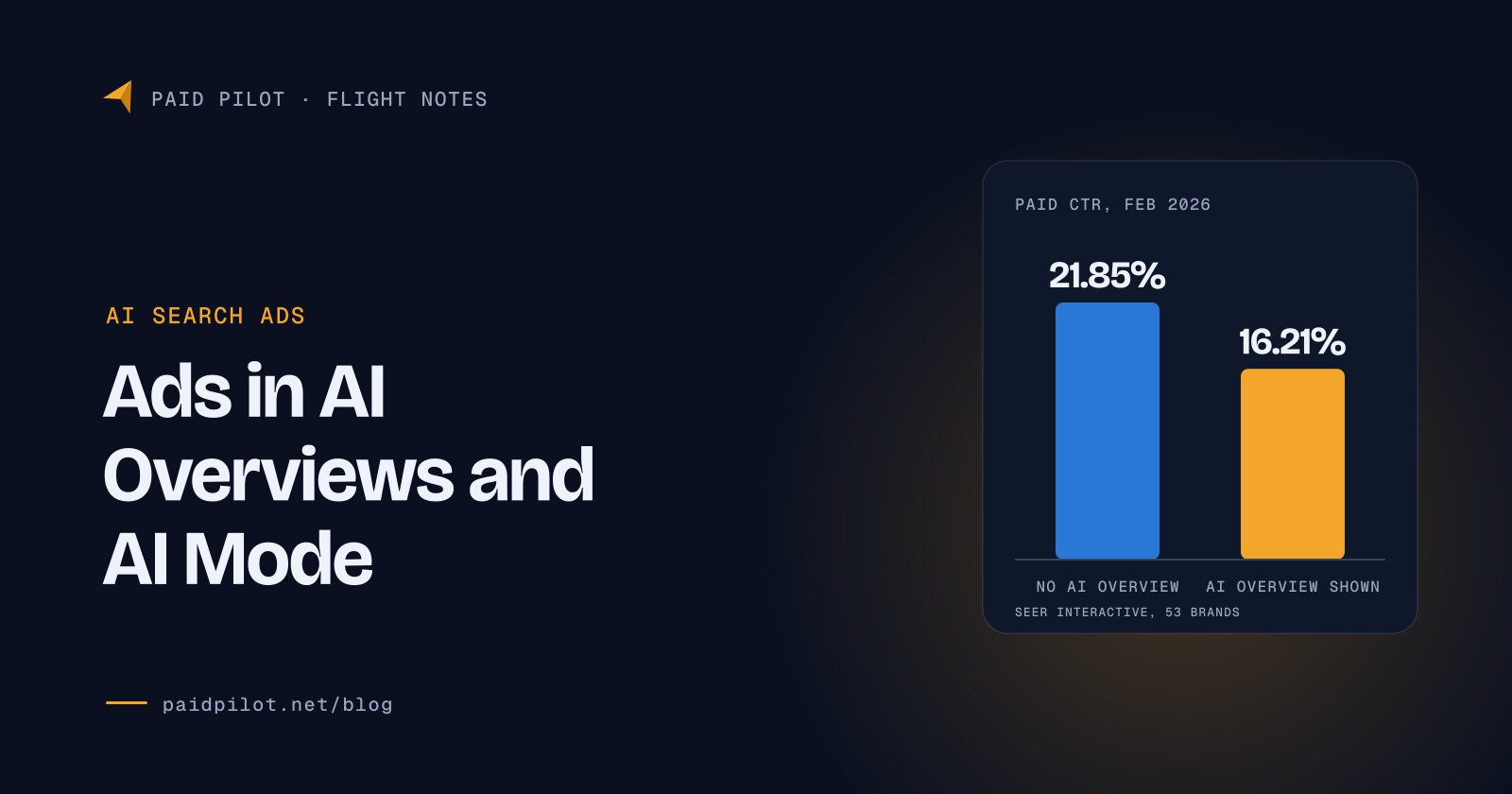
- Paid clicks drop when an AI Overview shows, but the gap has narrowed. Seer Interactive measured paid CTR of 16.21% with an AI Overview versus 21.85% without in February 2026, across 53 brands (Seer Interactive).
- There is no separate report. Google includes AI Overviews and AI Mode results in aggregate in standard campaign reports and the search terms report (Google Ads Help).
What are ads in AI Overviews and AI Mode?
They are paid ads that appear within or next to the AI generated answers in Google Search. Google labels every one of them “Sponsored” and says they are “visually distinguished from organic content” (Google Ads Help).
Two Google features are involved:
- AI Overviews are the short AI summaries that appear at the top of some normal search results pages. Google says they show only when its systems judge them additive to classic Search, so they often don’t trigger (Google Search Central).
- AI Mode is a separate, conversational search experience for deeper questions, comparisons and follow-ups. It can run several related searches at once (Google calls this “query fan-out”) to build a longer answer (Google Search Central).
Google may also show an AI explainer next to an ad. This is Gemini generated text, it is not part of your headline or description, and advertisers can’t write, edit, approve or opt out of it (Google Ads Help). That matters if you are careful about claims: the words next to your ad may not be yours.
Where can your ads appear, and which campaigns are eligible?
Placement above or below an AI Overview is open to almost everyone; placement inside the AI answer is narrower. Google’s two help pages set out the rules, summarized below.
| Placement | Eligible campaigns | Ad formats | Where |
|---|---|---|---|
| Above or below an AI Overview | Search, Shopping, Performance Max, App | Text, Shopping, local and app ads | All 200+ markets with AI Overviews, all languages |
| Inside an AI Overview | Search, Shopping, Performance Max | Text and Shopping ads | US plus 11 countries, English only |
| Inside AI Mode | Search, Shopping, Performance Max | Text and Shopping ads (local inventory and vehicle ads in testing) | US plus 10 countries, English; UK, Brazil and Mexico planned for Q4 2026 |
Sources: About ads and AI Overviews, About ads in AI powered experiences and Google, 28 October 2026. Indonesia is listed for AI Overviews only, and Pakistan for text ads only.
Google also excludes ads inside AI Overviews for sensitive verticals, naming adult, alcohol, gambling, finance, healthcare and politics “and more” (Google Ads Help). Google does not publish the full list, so a medical or financial business should not plan on appearing inside the answer.
How Google decides which keywords match
Google describes two kinds of matching (Google Ads Help). When someone types a query with clear commercial intent, any eligible keyword can match, including exact and phrase match. When the question is exploratory, Google matches on the query plus the AI response itself, and only AI Max for Search, broad match, Shopping and Performance Max can take part. If your account runs only exact and phrase match, you will mostly miss the conversational placements. Our earlier guide to AI Max for Search covers what that setting changes.
What changed in 2026?
In short: AI Mode became an ad surface of its own, ads began following people into follow-up questions, and Google started testing ad formats written by Gemini.
Ads in AI Overviews launch for mobile users in the US, for Shopping, Performance Max and AI powered Search campaigns (Search Engine Journal).
Google publishes its help page on ads and AI Overviews; ads inside AI Overviews run in English in the US on mobile and desktop (Search Engine Roundtable).
Ads inside AI Overviews expand to 11 more English speaking countries, including Canada, Australia and India (PPC Land).
At Google Marketing Live, Google announces two AI Mode formats in testing: Conversational Discovery ads and Highlighted Answers (Google).
Ads in AI Mode expand to 10 more countries, and Google launches multiturn ads in the US so ads can show on follow-up queries (Google).
The two new AI Mode formats
- Conversational Discovery ads answer a person’s specific question with creative that Gemini builds from your assets, according to Google’s May 2026 announcement.
- Highlighted Answers let a “highly relevant, high quality” ad appear inside a list of recommendations that AI Mode gives, with a Sponsored label (Google).
Both are tests, with no country list or launch date. Google says the new formats are “Powered by AI Max and Performance Max” (Accelerate with Google), so accounts built only on tight keyword lists may see little of this inventory.
How many people use AI Overviews and AI Mode?
Enough that you should assume some of your searchers see them. Google reported in May 2026 that AI Mode had passed a billion monthly active users worldwide, one year after its US launch (Google; coverage by Search Engine Journal).
1 billion+
monthly active users of AI Mode worldwide (May 2026)
3x
length of the average AI Mode query versus a traditional search
1 in 5
AI Mode searches globally that use voice, images or documents (Q3 2026)
200+
markets where ads can show above or below AI Overviews
Sources: Google, 19 May 2026, Alphabet Q3 2026 CEO remarks, 28 October 2026, Google Ads Help.
Longer queries matter because a long question rarely matches a short keyword list. Google also said its year over year query growth rate in Q3 2026 was the highest in five years, including commercial queries (Alphabet Q3 2026 remarks).
Ads inside the answer are still uncommon, though. Adthena data reported by PPC Land in April 2026, collected from November 2025 to March 2026, found that 0.12% of tracked US queries triggered an AI ad placement. Home and Services logged 10,750 US ad appearances in that data, ahead of Education at 8,652.
Do ads still get clicked when an AI Overview shows?
Yes, but less often. The best public dataset we found is Seer Interactive’s, which tracked 296.9 million paid impressions across 53 brands from January 2025 to February 2026. Paid CTR was lower whenever an AI Overview appeared, though the gap shrank over the period.
Paid click-through rate with and without an AI Overview
Seer Interactive, 53 brands, 5.47 million queries, selected months January 2025 to February 2026
- No AI Overview
- AI Overview shown
See the data
| Item | No AI Overview | AI Overview shown |
|---|---|---|
| Jan 2025 | 25.98% | 14.64% |
| Jun 2025 | 18.06% | 14.17% |
| Dec 2025 | 20.96% | 15.14% |
| Feb 2026 | 21.85% | 16.21% |
In our arithmetic, the gap went from about 11.3 percentage points in January 2025 to about 5.6 points in February 2026. Seer itself says it “cannot claim causation”, and its brands are large advertisers, so treat this as direction, not a forecast for your account.
Being cited in the AI answer helps paid clicks too
Seer also split results by whether the brand was cited in the AI Overview. On informational queries across 2025, brands that were cited earned noticeably higher paid CTR than brands that were not.
| Situation | Paid CTR | Organic CTR |
|---|---|---|
| No AI Overview | 19.75% | 3.35% |
| AI Overview, brand cited | 15.74% | 2.07% |
| AI Overview, brand not cited | 11.19% | 0.94% |
Source: Seer Interactive, 24 April 2026.
Organic clicks fall further. A Pew Research Center study of 900 US adults’ real Google searches in March 2025 found people clicked a traditional result on 8% of visits when an AI summary appeared, against 15% when it did not. Pew did not measure ads, but it shows why a paid position near the answer can matter more than it used to.
How often Google users clicked a result
Share of visits to a results page, 900 US adults, searches in March 2025
See the data
| Item | Value |
|---|---|
| No AI summary on the page | 15% |
| AI summary on the page | 8% |
| Link inside the AI summary | 1% |
For AI Mode specifically, Google says click-through rates are “already similar between sponsored and organic product list items”, based on its internal US data from 20 August to 3 September 2026 (Google). Google published no rates, and that claim covers product listings, not text ads.
What can you control, and what can’t you?
You control the inputs (keywords, match types, negatives, bids, assets and landing pages), not the placement.
What you can’t do
- Target ads only to AI Overviews or AI Mode, or bid separately for them (Google Ads Help).
- Opt out of these placements while staying in Search (Google Ads Help).
- See a separate segment for AI Overview or AI Mode performance. Google says results are included “in aggregate” and ads in AI Overviews are reported as Top Ads (Google Ads Help).
- Edit or switch off the AI explainer text that may appear next to your ad (Google Ads Help).
What you can still do
- Block irrelevant queries with negative keywords, which Google confirms still control serving (Google Ads Help).
- Use brand exclusions to keep broad match and AI Max away from brands you don’t want to appear for.
- Review the search terms report, where queries that triggered these ads appear in aggregate.
- Pin headlines or descriptions where wording must stay fixed. PPC Land lists asset pinning among the controls that still apply.
- Choose your match types deliberately. Exact and phrase match keep you to direct buying queries; broad match and AI Max open the conversational inventory.
Billing does not change: you pay the same cost per click or conversion based bid as a standard search ad, with no extra fee for the placement (Google Ads Help).
What does this mean for local and service businesses?
Your existing Search campaign is already eligible, so the real question is whether it is built to take part sensibly.
- Local Services Ads are not on the list. Google’s help pages name text and Shopping ads as the formats inside AI Overviews and AI Mode, with local inventory and vehicle ads in testing. They do not mention Local Services Ads for these placements, so treat Local Services Ads as a separate channel for now.
- Healthcare and finance are excluded inside AI Overviews. Dental, medical and financial advertisers can still show above or below the AI Overview, but should not expect a slot within it (Google Ads Help).
- Long questions reward broad match with good guardrails. A homeowner asking AI Mode to compare repair options is a likely place for a contextual ad, and only broad match, AI Max, Shopping and Performance Max can match there.
- Your landing page does more work. If the AI answer has already explained the basics, the person who clicks wants a price range, availability and a way to book.
An illustration with a fictional business: Cedar Hollow Plumbing runs only exact and phrase match on “water heater repair”. A long AI Mode question about repairing or replacing a 12 year old heater is exploratory, so under Google’s rules only broad match or AI Max could reach it. Only Cedar Hollow’s own conversion data can say whether that traffic is worth buying.
How to prepare your Google Ads account for AI answers
You can’t buy the placement, so prepare the account that feeds it.
- Confirm conversion tracking first. AI placements are blended into normal reports, so conversions are the only way to judge whether broader matching pays. Calls, forms and bookings should all count.
- Set a match type policy on purpose. If you test broad match or AI Max to reach conversational queries, start with one campaign and a learning budget, with Smart Bidding pointed at real conversions.
- Build and refresh negative keyword lists. Longer AI queries bring looser matches. Our free negative keyword generator is a quick start.
- Read the search terms report weekly. Long, question style queries are the clearest sign your ads are matching AI style searches.
- Give Google complete assets. Google recommends high quality creative for these placements (Google Ads Help), so fill every headline, description, sitelink and image slot.
- Keep Shopping feeds current. Google tells Shopping advertisers to keep feeds up to date for these placements (Google Ads Help).
- Fix the landing page. State prices or price ranges, service area and the next step clearly, because the visitor has often read an AI summary first.
For a fuller review, use our Google Ads audit checklist. If you are weighing AI ads outside Google, our guides to ChatGPT ads and Microsoft Ads vs Google Ads cover those options.
How Paid Pilot handles ads in AI search
Paid Pilot manages Google Ads only: Search, Local Services Ads, Performance Max and Shopping. For AI placements we focus on what can be controlled (conversion tracking, match types, negative keywords and weekly search term reviews), so broader matching is tested against real leads rather than switched on blindly. Plans start at $499 a month on the Launch plan for ad budgets up to $3,000 (pricing), and you can get a free recorded audit of your current account first.
Frequently asked questions
No. Google says existing Search, Shopping and Performance Max campaigns are eligible automatically for AI Overviews and AI Mode. There is no separate budget, no new campaign type and no extra charge. Ads enter the same auction and you pay the same cost per click or conversion based bid as a standard search ad.
No. Google states you can’t opt out of these placements separately, and you can’t target them exclusively either. You can only influence where your ads show through the normal controls: negative keywords, brand exclusions, match types, bids and your assets.
Not separately. Google includes performance from AI Overviews and AI Mode in aggregate within standard campaign reports, and reports ads in AI Overviews as Top Ads. Queries that triggered them appear in the search terms report, also in aggregate. Google says it will share more about reporting in future.
Ads inside AI Overviews run in English in the US, Australia, Canada, India, Indonesia, Kenya, Malaysia, New Zealand, Nigeria, Pakistan, the Philippines and Singapore, according to Google Ads Help in November 2026. Ads above or below AI Overviews can show in all 200+ markets where AI Overviews are available.
Google’s help pages do not list Local Services Ads among the formats that appear inside AI Overviews or AI Mode. They name text ads and Shopping ads, with local inventory ads and vehicle ads in testing. Local Services Ads still run in their own placements, so treat them as a separate channel for now.
Sometimes. Google says exact and phrase match keywords match only when a query shows direct commercial intent. For broader, exploratory questions, Google matches ads using the query and the AI response, and only AI Max for Search, broad match, Shopping and Performance Max can take part in that contextual matching.
Sources
- About ads in AI powered experiences in Google Search, Google Ads Help, accessed 9 November 2026.
- About ads and AI Overviews, Google Ads Help, accessed 9 November 2026.
- Ads in AI Mode expand to new markets, Google (Shashi Thakur), 28 October 2026.
- A new generation of ads for the AI era of Search, Google, 20 May 2026.
- Ads in AI Mode, Accelerate with Google, 20 May 2026.
- How AI Mode is changing the way people search in the U.S., Google (Shivani Mohan), 19 May 2026.
- Q3 2026 earnings call: Remarks from our CEO, Google, 28 October 2026.
- AI features and your website, Google Search Central, updated 10 December 2025.
- AIO Impact on Google CTR: 2026 Update, Seer Interactive, 24 April 2026.
- Google users are less likely to click on links when an AI summary appears in the results, Pew Research Center, 22 July 2025.
- Adthena’s 29M query report reveals what’s actually working in AI search ads, PPC Land, 4 April 2026.
- Advertisers in 10 more countries can’t opt out of Google’s AI Mode ads, PPC Land, 1 November 2026.
- Google quietly expands AI Overview ads to 11 countries without fanfare, PPC Land, 22 December 2025.
- Google Expands Ads In AI Mode To More Countries & Multiturn Ads In U.S., Search Engine Roundtable, 28 October 2026.
- Google Expands Ads In AI Overviews To More Countries But Not For Sensitive Verticals, Search Engine Roundtable, 22 December 2025.
- Google Ads Help Doc On Ads In AI Overviews & Experiences, Search Engine Roundtable, 26 May 2025.
- Google Officially Launches Ads In AI Overviews, Search Engine Journal, 3 October 2024.
- Google Reveals First AI Mode Usage Numbers After One Year, Search Engine Journal, 20 May 2026.